

 English
 русский
 Español
 عربى
 中文简体
 中文简体
Content
- 1 What a Pulverizing Mill Does, and What It Cannot Do
- 2 Mill Designs and the Materials They Suit
- 3 Why Plastics Plants Usually Choose Disc Mills or Knife Mills
- 4 Reading a Powder Specification Without Being Misled
- 5 What to Put in a Pulverizing Mill Inquiry
- 6 Wear Parts, Energy, and the Real Cost per Tonne
The most common powder problem on a rotomolding or masterbatch line is not a broken mill. It is a mill bought for the wrong job: right price, right footprint, wrong combination of screen, rotor speed, and cutting geometry for the material in front of it.
The conclusion first. A pulverizing mill should be selected against three numbers, not one: the target particle size with the top cut you will actually accept, throughput in kilograms per hour at that fineness, and the highest temperature the material tolerates in the grinding zone. Motor power follows from those three; it does not define them. A well-set 45 kW disc mill will often beat a badly set 75 kW unit on both output and powder quality, while using less energy per tonne.
The sections below cover how the main designs reduce plastic, where disc and knife mills fit, how to read a mesh specification, and what belongs in an inquiry so that quotes come back comparable.
What a Pulverizing Mill Does, and What It Cannot Do
A pulverizing mill reduces solid material to a controlled particle size using impact, shear, attrition, or a combination of the three. In plastics the useful output is powder, usually between about 150 and 800 microns. The quality measure is not the average particle size alone but the shape of the whole distribution: how much sits above the top cut, how much falls below 100 microns as fines, and how stable those proportions stay across a full shift.
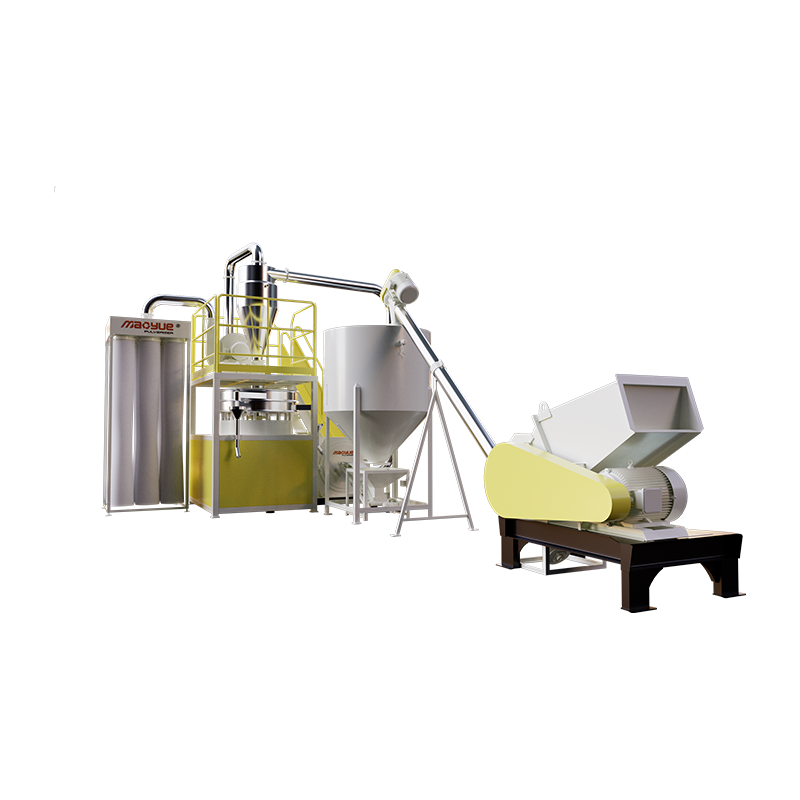
Two terms get mixed up in quotations, and the confusion costs buyers time. A granulator or crusher breaks scrap into flakes of roughly 6 to 12 mm. A pulverizing mill takes those flakes, or virgin pellets, down to powder. A supplier who blurs the two will quote a machine that does one job well and the other badly.
A mill also cannot do work that belongs upstream. It will not remove metal, grit, or paper, and it will not dry damp feedstock. If your regrind is inconsistent, fix that first, or you will pay for it twice — once in powder quality and again in accelerated wear.
If the vocabulary is still unfamiliar, this explanation of what a plastic pulverizer does sets out the difference between crushing and grinding in plain terms.
Mill Designs and the Materials They Suit
The table is a shortlisting filter, not a specification. Final fineness and output depend on the material's toughness, the screen or classifier, rotor speed, feed moisture, and how evenly the feed is metered.
| Design | How it reduces material | Typical fineness | Where it fits |
|---|---|---|---|
| Hammer mill | Swinging hammers strike material against a breaker plate and screen | 10-80 mesh | Brittle, friable feed; pre-grinding; filled compounds |
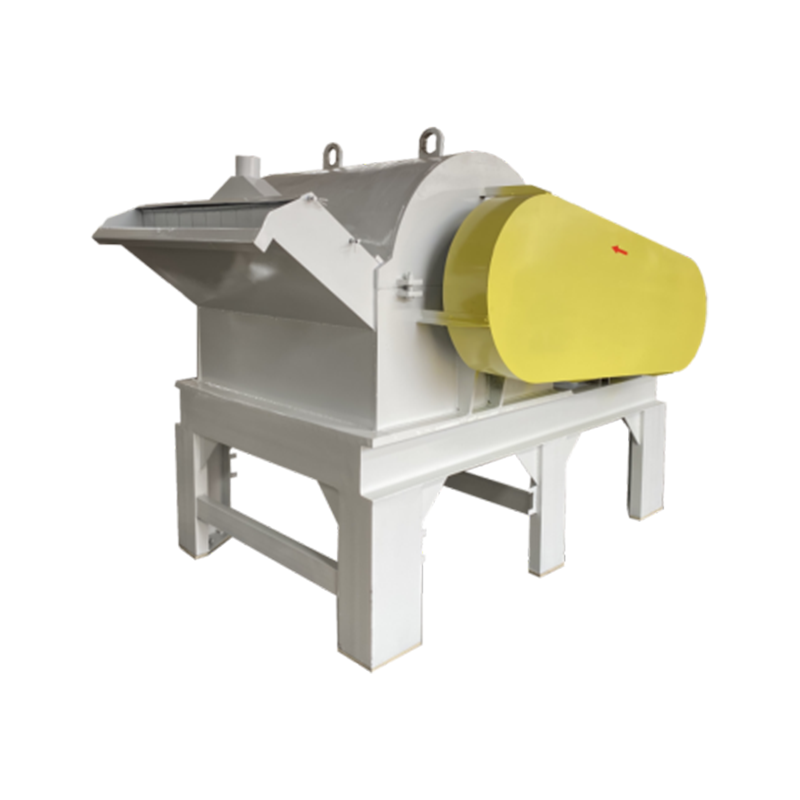
| Knife mill | Rotating blades shear against fixed bed knives, discharging through a screen | 8-40 mesh | PVC, PE scrap, pipe and profile waste, purging lumps |
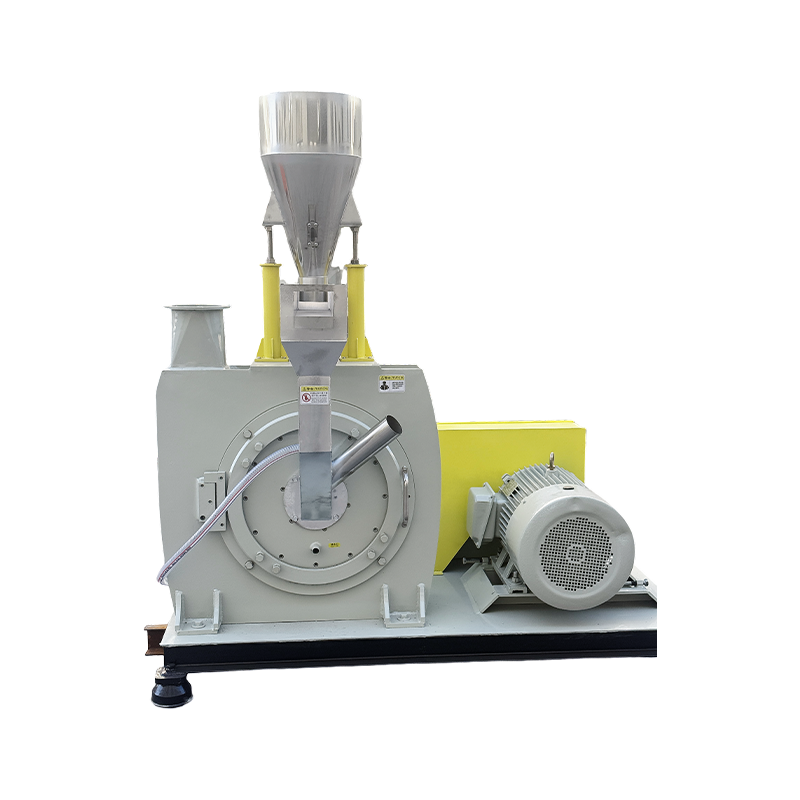
| Disc mill | Shear and attrition between a rotating toothed disc and a fixed ring | 30-120 mesh | PE for rotomolding, masterbatch, PP, PA |
| Ball mill | Tumbling media crush by impact and attrition | Under 50 microns | Minerals, pigments, heavily filled systems |
| Jet mill | Particle-on-particle impact in a gas stream | 1-20 microns | High-value, heat-sensitive specialty powders |
Why Plastics Plants Usually Choose Disc Mills or Knife Mills
For plastics the field narrows quickly. Ball and jet mills cost too much per tonne for commodity resin, and hammer mills work but run hot and produce a wider spread. What remains is the disc mill for polyolefins and masterbatch, and the knife mill for PVC and mixed scrap.
Polyethylene for Rotomolding
Rotomolding is the most sensitive common application. Standard practice is a 35-mesh powder, about 500 microns, with a tight top cut. Oversize particles do not melt at the same rate as the rest of the load, so they leave unmelded specks or gel spots on the part surface, while too many fines cause bubbles, smoke, and uneven wall thickness. A disc mill with an internal classifier and strong airflow through the grinding zone handles this well: it keeps the material cool and returns oversize for another pass instead of forcing it through the screen.
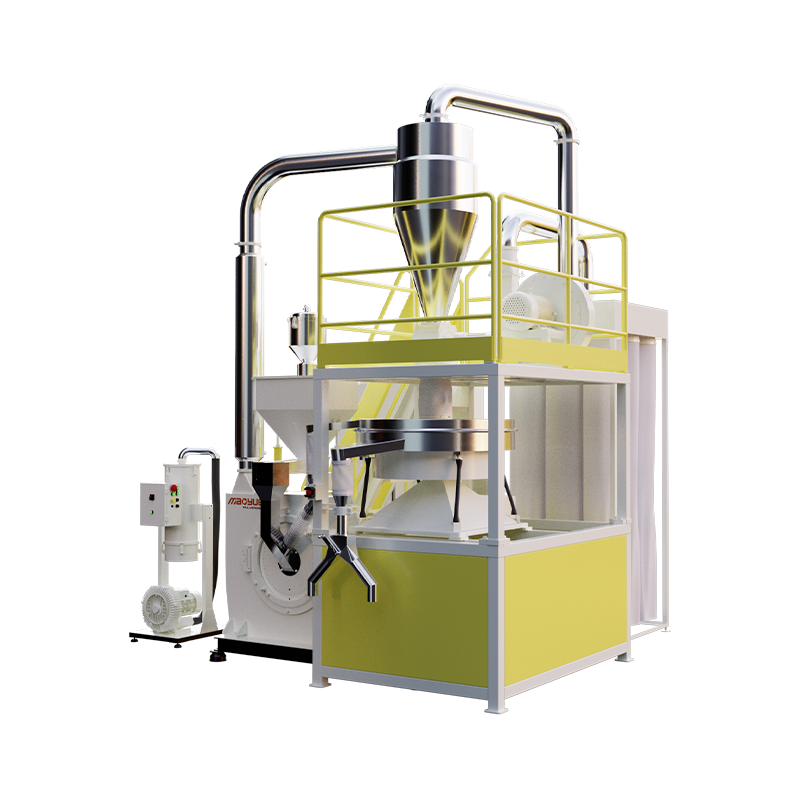 Mao Yue 600-Type PE Rotomolding Powder PulverizerMedium-to-large PE rotomolding pulverizer with 300–800 kg/h output and 20–100 mesh adjustability, suited to uniform powder production.View Product →
PA and PP at Room Temperature
Polyamides and polypropylene are tougher and more heat sensitive than PE. Cryogenic grinding with liquid nitrogen solves the temperature problem cleanly, but it adds a consumable cost to every tonne and requires nitrogen supply on site. Ambient grinding is the alternative when the machine is built for it: a rotor that generates shear without excess heat, an air path that carries heat out with the powder, and a discharge that does not let material sit in the chamber. Nitrogen-free PA and PP machines are designed around exactly that idea, and the saving is simple to calculate — no nitrogen bill, no cryogenic plumbing, no venting.
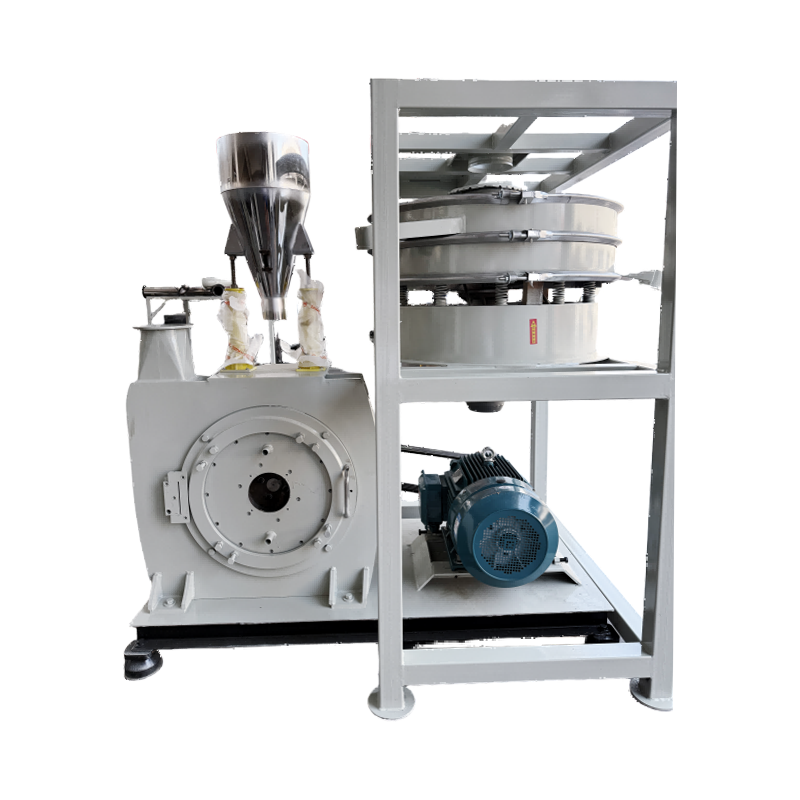 Mao Yue 500PA/PP Ambient Temperature GrinderEntry-level PA/PP grinder operating without liquid nitrogen, with 20–100 mesh fineness and ±3–5°C chamber control for small batches.View Product →
Reading a Powder Specification Without Being Misled
"Fine powder" is not a specification. Before comparing two mills, agree on how the powder will be measured.
| Mesh | Approximate opening | Typical use |
|---|---|---|
| 20 mesh | 841 microns | Coarse rotomolding grades, some extrusion compounds |
| 35 mesh | 500 microns | Standard rotomolding powder |
| 60 mesh | 250 microns | Fine rotomolding, masterbatch carrier |
| 80 mesh | 177 microns | Masterbatch, thin-wall parts |
| 100 mesh | 149 microns | Fine masterbatch, coating powders |
| 200 mesh | 74 microns | Specialty and high-clarity applications |
The number that matters most in production is the top cut, meaning the proportion retained on your target sieve. A powder with a median of 400 microns and 2 percent oversize usually runs better than one with a median of 450 microns and 12 percent oversize. Ask how the sieve test is run as well: sample mass, sieving time, shaker or air jet, and whether the figure is an average of three samples. A supplier who cannot state the method is not giving you a comparable number.
What to Put in a Pulverizing Mill Inquiry
Vague inquiries produce vague quotes. Send these details and the replies become comparable line by line:
- Polymer type, grade, and filler content by percentage — glass and calcium carbonate change wear rate sharply.
- Feed form and maximum lump size: pellets, flakes, regrind, or purging blocks.
- Target fineness in mesh or microns, with an acceptable top cut and fines limit.
- Required output in kg/h at that fineness, not at a wide-open screen.
- Bulk density of feed and finished powder, for silo and conveying sizing.
- Available power, voltage, and phase, plus dust extraction, noise limits, and ceiling height.
- Wear-part prices, blade and disc drawings, warranty terms, and commissioning support.
If two suppliers answer all seven points in the same units, the cheaper machine is not automatically the lower-cost machine. Compare the wear-part price per kilogram of powder produced.
Wear Parts, Energy, and the Real Cost per Tonne
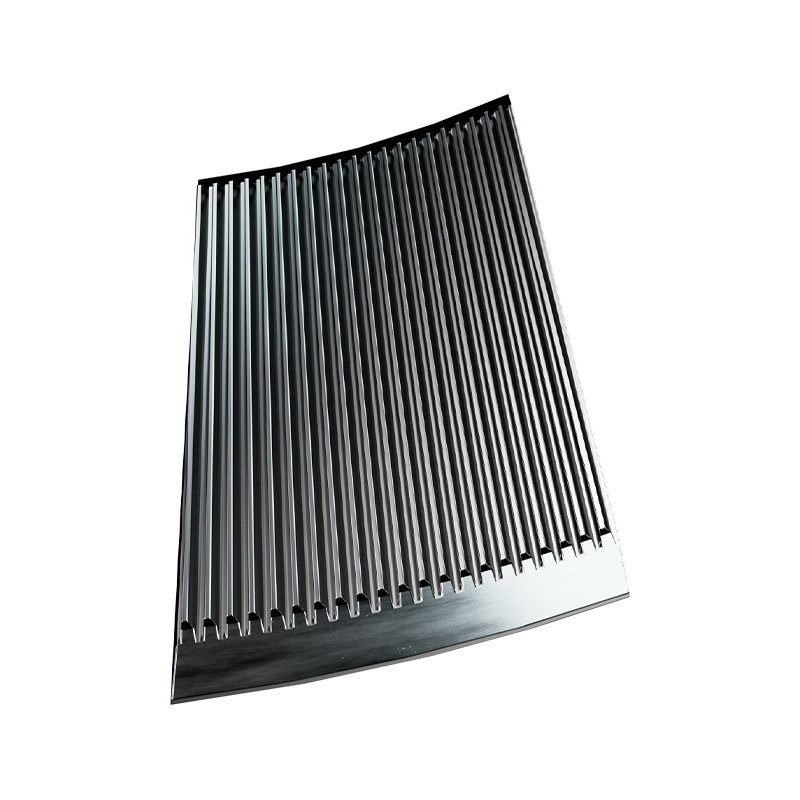
A pulverizing mill is a wear machine before it is anything else. Blades, disc teeth, screens, and rotors consume budget on a predictable schedule, and that schedule is set by what you feed the machine: unfilled PE is gentle, 30 percent glass-filled PA is not. Alloy steel blades and hardened discs last longer between changes, but the bigger factor is keeping knife-to-bed clearance inside the manufacturer's tolerance and rebalancing after every blade change. A rotor that is 20 grams out of balance will shorten bearing life and widen the particle spread long before it fails outright.
Rigid PVC is the abrasive case in point. It is also thermally unstable, so a mill that runs hot will produce discoloured powder faster than it produces output.
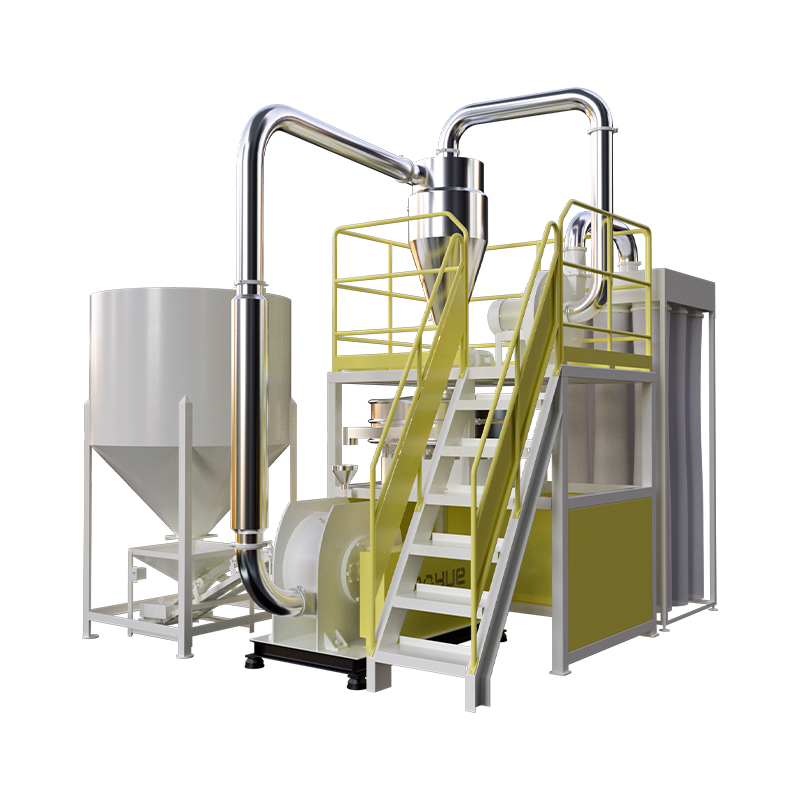 Mao Yue 850 PVC Wear-Resistant PulverizerLarge PVC pulverizer for abrasive rigid scrap, with wear-resistant alloy discs, dual cooling, and 700–1,000 kg/h stated output.View Product →
Energy is the second half of the equation. Specific energy per tonne climbs quickly when a mill is asked to grind beyond its design point: worn screens, blunt blades, and an over-throttled feed all push the same material through twice. Log kWh per tonne monthly alongside blade condition, and the pattern shows up before the maintenance bill does.
The practical summary: match the mill to the powder your process actually needs, not to the biggest motor in the catalogue. Get a distribution sample, state the sieve standard, trial your own material, and price the wear parts before you sign — that is where the running cost hides.
If you are weighing options now, the plastic pulverizer range shows the disc, knife, and ambient-grinding configurations described above, with model sizes from 500 to 900. Send the details from the checklist — material and filler content, feed form, target mesh with top cut, required kg/h, and available power — and any quote you receive will be worth comparing.