Rotor Dynamic Balance Is the Foundation of High-Speed PVC Pulverizing
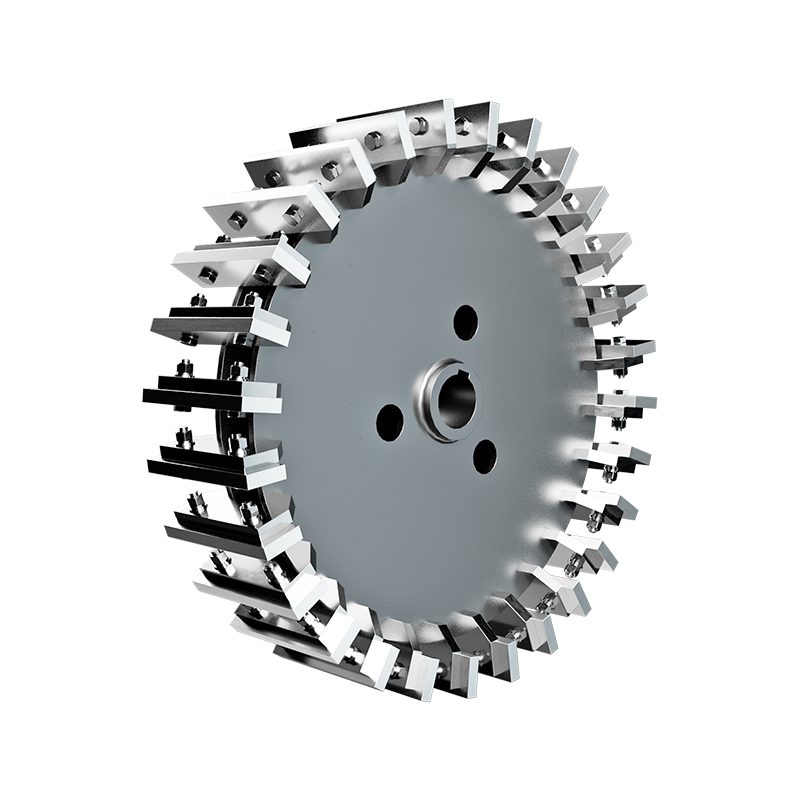
In a modern grinding system, the PVC Pulverizer Rotor is far more than a rotating shaft that supports cutting components. It is the core element responsible for transferring power, maintaining rotational stability, and generating a consistent shearing action throughout the pulverizing chamber. Since industrial PVC pulverizers typically operate at several thousand revolutions per minute, even a slight imbalance in rotor mass distribution can produce substantial centrifugal forces. These forces increase vibration amplitude, accelerate bearing fatigue, reduce grinding accuracy, and ultimately affect powder quality.
Manufacturers therefore perform dynamic balancing after the rotor has been completely machined and assembled instead of balancing individual components separately. This process compensates for manufacturing tolerances, ensuring that the rotating assembly remains stable under actual operating conditions. A well-balanced rotor not only improves machine reliability but also reduces noise, lowers maintenance frequency, and contributes to more consistent particle size distribution.
Typical Effects of Rotor Dynamic Balance
| Rotor Condition |
Influence on Pulverizing Performance |
| Excellent balance quality |
Stable operation and consistent powder size |
| Minor imbalance |
Increased vibration and gradual bearing wear |
| Severe imbalance |
Reduced equipment life and unstable particle distribution |
Rotor Rigidity Determines Grinding Stability Under Continuous Load
Rotor stiffness directly affects the operating behavior of a PVC Pulverizer Rotor during long production cycles. A shaft with insufficient rigidity may experience elastic deformation under centrifugal loading, causing variations in grinding clearance between the rotating and stationary discs. Even microscopic changes in clearance can alter the shearing mechanism, leading to inconsistent powder morphology and higher energy consumption.
Finite element analysis is increasingly used to evaluate rotor deflection, stress concentration, and natural frequency before manufacturing begins. Proper structural design ensures that the operating speed remains well below the critical speed of the rotor, preventing resonance and maintaining stable process conditions throughout continuous operation.
Engineering Factors Affecting Rotor Rigidity
- Shaft diameter influences bending resistance under centrifugal loading.
- Bearing span determines overall structural stiffness.
- Material modulus affects elastic deformation during operation.
- Proper rotor geometry minimizes stress concentration at key transitions.
Thermal Expansion Should Be Considered During Rotor Design
Although cooling systems help maintain acceptable operating temperatures, every PVC Pulverizer Rotor experiences thermal expansion during continuous production. Uneven temperature distribution may alter shaft straightness, bearing preload, and grinding disc alignment. Engineers therefore evaluate thermal deformation together with mechanical loading when designing precision rotor assemblies.
Selecting appropriate shaft materials, optimizing lubrication systems, and ensuring uniform heat dissipation all contribute to maintaining rotor dimensional stability. These measures reduce unexpected clearance variation and help preserve consistent pulverizing performance even during extended production campaigns.
Sources of Rotor Temperature Rise
| Heat Source |
Potential Impact |
| Bearing friction |
Localized shaft expansion |
| Material shearing |
Increased grinding chamber temperature |
| High rotational speed |
Additional thermal loading on rotor components |
Predictive Monitoring Extends Rotor Service Life
Instead of waiting for mechanical failure, many advanced polymer processing facilities monitor the condition of the PVC Pulverizer Rotor using vibration analysis, bearing temperature, acoustic emission, and motor current trends. These indicators provide early warning of imbalance, shaft misalignment, bearing degradation, or component fatigue before they affect production quality.
Integrating predictive maintenance into pulverizing operations reduces unplanned downtime while improving overall equipment effectiveness (OEE). Maintenance activities can be scheduled based on actual equipment condition rather than fixed operating hours, maximizing component utilization and minimizing production interruptions.
Precision Rotor Engineering Supports the Entire Pulverizing Process
Although grinding discs and cutting components often receive the most attention, their performance ultimately depends on the precision of the rotor that supports them. Rotor concentricity, dynamic stiffness, machining accuracy, and assembly tolerances collectively determine whether the pulverizing system can maintain stable particle size distribution over thousands of production hours. As manufacturing requirements become increasingly demanding, rotor engineering has evolved into one of the most critical factors affecting process capability and long-term operational reliability.
Changzhou Mao Yue Intelligent Equipment Co., Ltd. has accumulated more than 30 years of experience in plastic pulverizing technology and was one of the pioneers of the plastic pulverizer market. Every core component is manufactured according to European quality standards, ensuring that its renowned disc pulverizers consistently produce powders with narrow particle size distribution and excellent fluidity for rotational molding, masterbatch, and polymer applications. The same engineering philosophy is applied to every PVC Pulverizer Rotor, where precision machining, rigorous balancing procedures, and strict quality control help customers achieve lower vibration levels, greater production stability, longer equipment service life, and higher overall process efficiency in demanding industrial environments.



 English
 русский
 Español
 عربى
عربى 中文简体
中文简体
 中文简体
中文简体