

 English
 русский
 Español
 عربى
 中文简体
 中文简体
Content
A rotomolding plant changes resin supplier and within a week the powder starts bridging above the feed screw. The usual reactions are to dry it harder, bolt a vibrator onto the hopper, or blame the new resin. A powder flowability test replaces that guessing with numbers you can write into a purchase specification.
The test measures how a bulk powder behaves under the stresses your equipment applies, not how it looks in a bag or feels between your fingers. Two powders with identical sieve results can discharge very differently, and the gap is usually measurable long before it turns into a rejected batch.
What a Powder Flowability Test Actually Measures
Flowability is the ability of a powder to move the way a specific piece of equipment needs it to move: out of a hopper, through a screw feeder, across a mold, into an extruder. That definition is deliberately equipment-specific, which is why a single number rarely settles a discussion between supplier and customer.
- Cohesion — how strongly particles hold onto each other with no external load. Fines, moisture and surface tack all raise it.
- Internal friction — resistance as particles slide past one another. Angular, milled particles generate more of it than rounded ones.
- Wall friction — resistance where powder meets steel, which decides whether a hopper needs a 60-degree cone or a 70-degree one.
- Compressibility and permeability — how much bulk density changes under load, and how easily air moves through the bed. Both influence flooding and rat-holing.
Conditions matter as much as the method. A result recorded at 10 kPa consolidation says little about discharge at 1 kPa in a shallow hopper. Always report the stress, the moisture content and the particle size distribution next to the flow value; without them the number cannot be reproduced or compared.
Test Methods and What Each One Returns
Most laboratories choose between a fast index test for routine checks and a shear test for design work. The table below sets out what the common methods actually deliver.
| Method | What it returns | Practical notes |
|---|---|---|
| Angle of repose | Heap angle in degrees | Fast and cheap; no stress control and sensitive to pouring technique |
| Tapped density, Carr index, Hausner ratio | Compressibility in percent, or a ratio | Ten minutes with a graduated cylinder; blind to friction and permeability |
| Orifice or funnel flow | Seconds to empty a standard cup | Fine for granules; cohesive plastic powders often simply block |
| Shear cell, direct or ring (ASTM D6128, ASTM D6773) | Cohesion, flow function, internal and wall friction angles | Basis for hopper design; trained operator and a few hundred grams of sample |
| Dynamic rheometry | Energy or torque per blade cycle | Good for ranking and aeration studies; not transferable to silo design |
| Rotating drum or avalanche | Avalanche angle and spread | Suits thin-layer flow such as powder spreading in a mold |
| Wall friction | Wall friction angle against a named steel | Needs the real wall material and surface finish |
Two practical notes. Funnel methods that work well for granules frequently jam with cohesive plastic powders, so a blocked funnel is a result rather than a failed test. Shear cell data are only as good as sample preparation: over-drying a sample can make a borderline powder look far better than it behaves on the plant floor.
Turning Numbers into a Pass or Fail Line
Boundary values published in standards and textbooks are conventions drawn from large sample sets, not physical laws. They are useful as screening filters, and they should never be the only sentence in a specification.
| Indicator | Free-flowing (typical) | Cohesive (typical) |
|---|---|---|
| Hausner ratio | under 1.25 | above 1.40 |
| Carr compressibility index | under 15 percent | above 25 percent |
| Angle of repose | under 30 degrees | above 40 degrees |
| Flow function ff (shear cell) | above 10 | below 4 |
Read the flow function with care. Between roughly 4 and 10 a powder is usually workable in a correctly proportioned hopper; below 4, expect arching; below 2, the material will only move with aeration, vibration or mechanical assistance. Keep the consolidation stress attached to the result, because a cohesive powder tested at 20 kPa is not comparable with a free-flowing one tested at 1 kPa.
For a purchase specification, name one index method for routine lot checks and one shear test for the qualification sample, then state the conditioning routine, the test stress and the acceptable range in the same document.
Why Milled Plastic Powders Are a Special Case
Shape matters more than median size. A pulverizer cuts and shears, so the output is angular and usually contains a plate-like fraction. Interlocking friction is therefore higher than for a spray-dried or crystallised powder of the same D50, and two samples can share a median size while behaving completely differently in the same hopper.
Fines dominate the behaviour. On rotomolding grades, a modest rise in the sub-100 micron fraction is often enough to move the Hausner ratio from around 1.2 into the 1.35 to 1.45 band, which is where bridging starts. Report the particle size distribution and the flow result together, never one without the other.
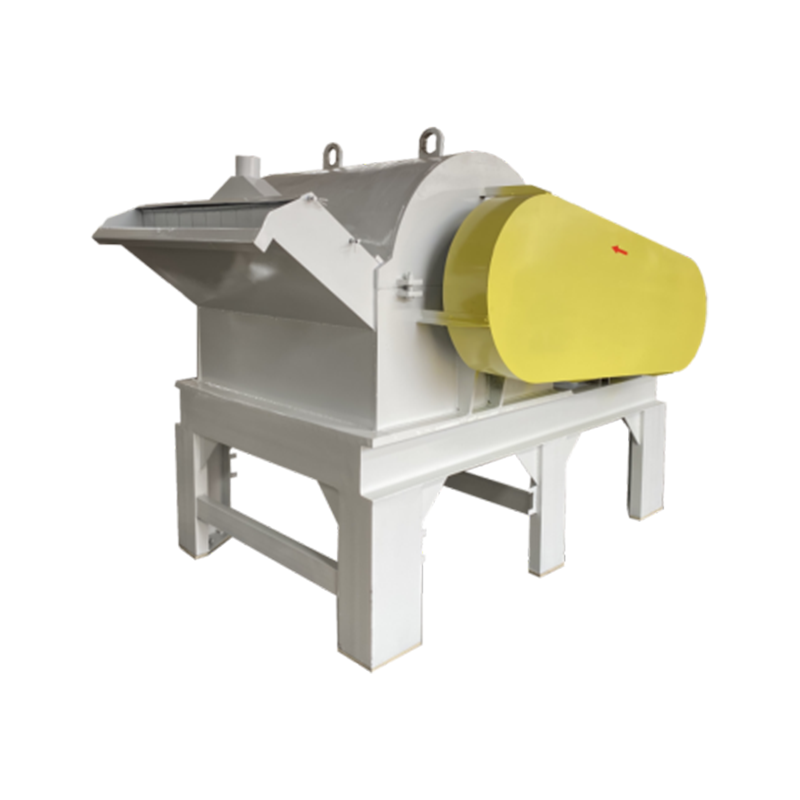
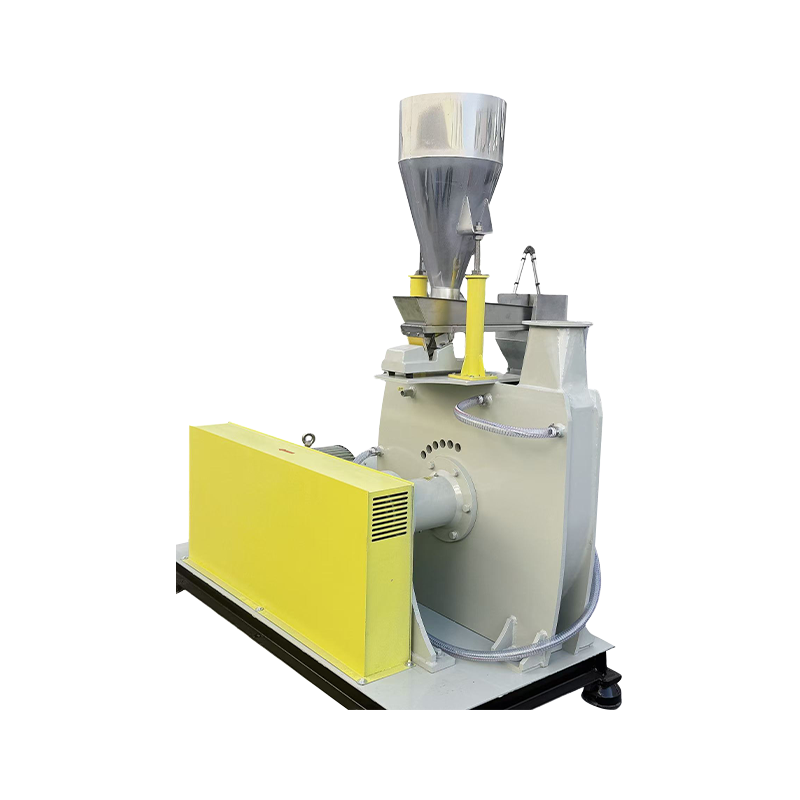
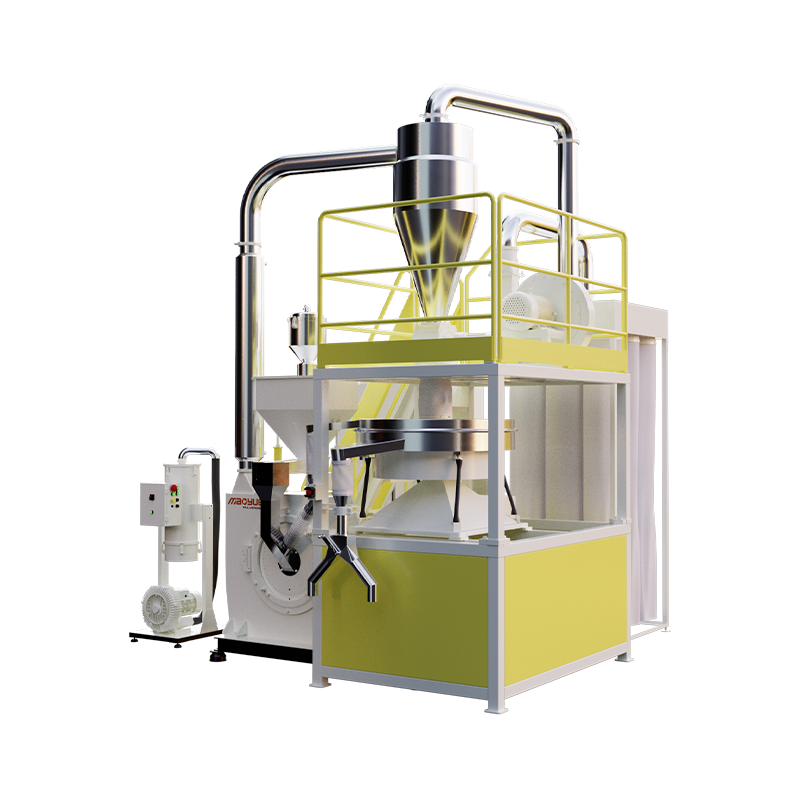 PE Rotomolding Powder Pulverizer Model 600A 600 mm disc pulverizer for PE rotomolding powder, with adjustable fineness and temperature-controlled grinding for consistent flow-focused production.View Product →
Chemistry adds its own effects. Polyamide picks up moisture from the air and becomes noticeably more cohesive within hours of grinding. Polypropylene is less hygroscopic but generates static in pneumatic conveying, producing the same symptom, sticking and rat-holing, for an entirely different reason.
Formulated compounds are harder still. Masterbatch and heavily filled compounds carry waxes, stearates and pigment agglomerates on the particle surface. Flow results can drift between lots even when the base resin and the mill settings have not changed, which makes a stored reference sample the most useful item in the laboratory.
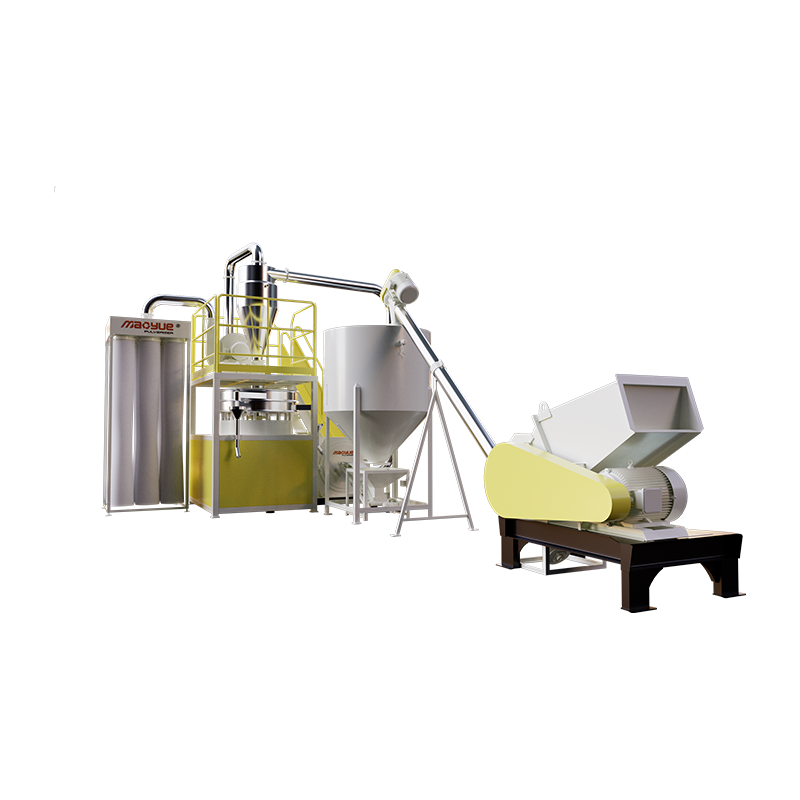
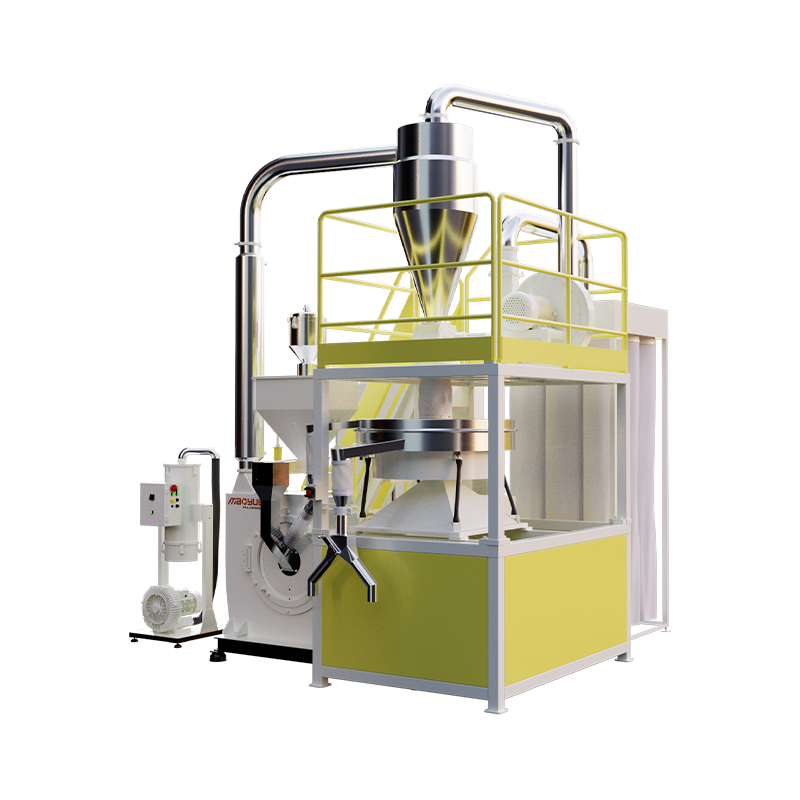
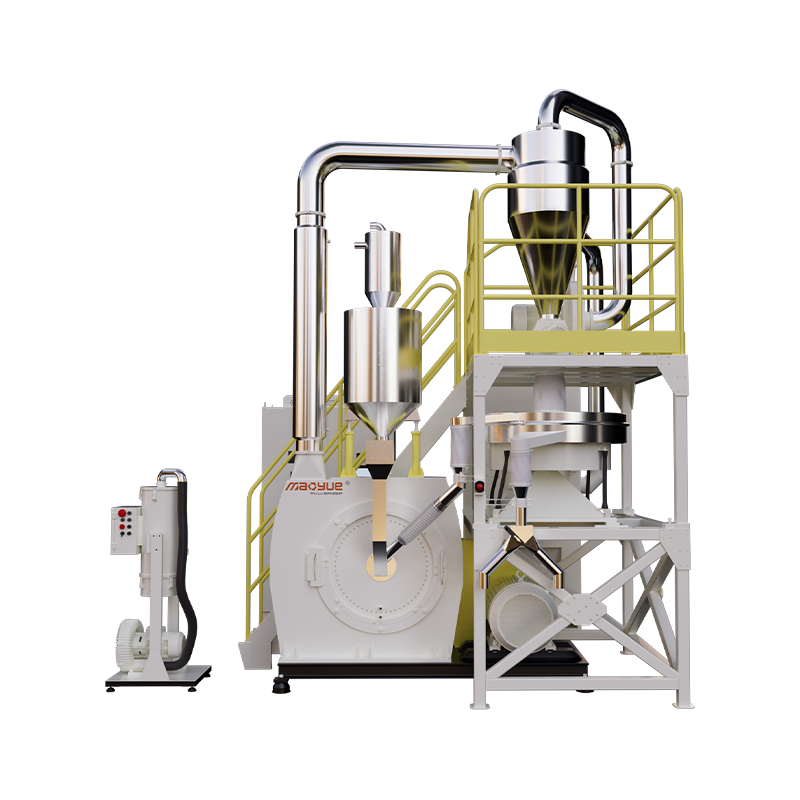 800 Series High-Capacity Masterbatch PulverizerFor masterbatch and filled-compound lines where lot-to-lot flow matters, this high-capacity pulverizer offers inverter speed control and dual cooling.View Product →
From Test Result to Pulverizer Setting
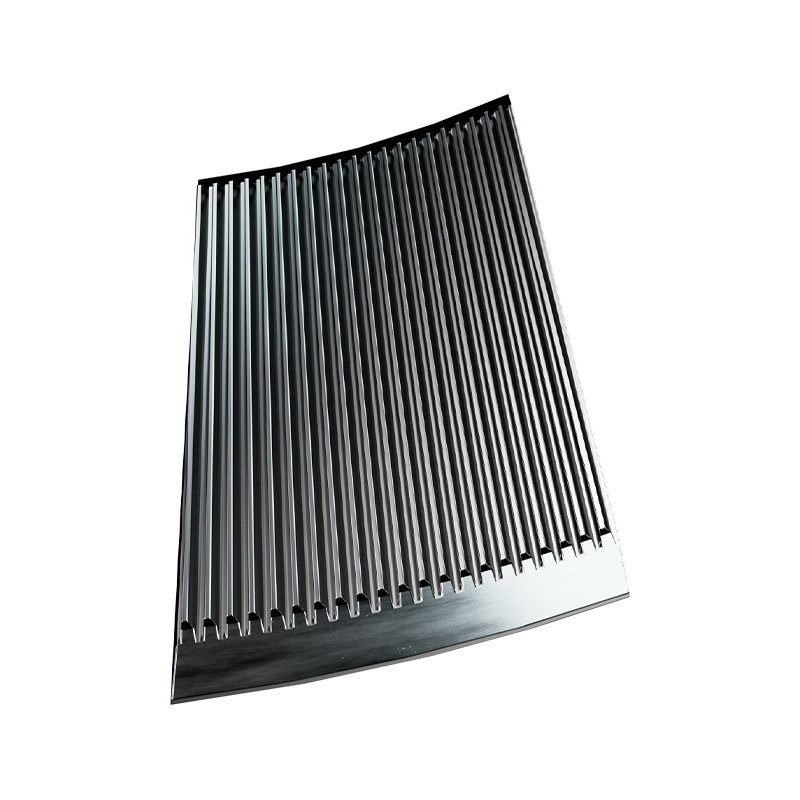
Flow data become useful when they point at a machine adjustment. If cohesion rises because the fine fraction has grown, the fix usually sits in classification, screen condition, feed rate or the clearance and sharpness of the grinding elements. The condition and design of the grinding disc shifts the whole distribution, so a blade or disc change should always be followed by a fresh flow check rather than an assumption that the output is unchanged.
Thermal history counts too. Ambient grinding of polyamide and polypropylene without liquid nitrogen keeps operating costs down, but a hot grind can round and slightly fuse particle surfaces. That may improve discharge while reducing bulk density and dispersibility, so both properties belong in the acceptance criteria. Equipment built for room-temperature processing reflects that trade-off in its cooling and feed design.
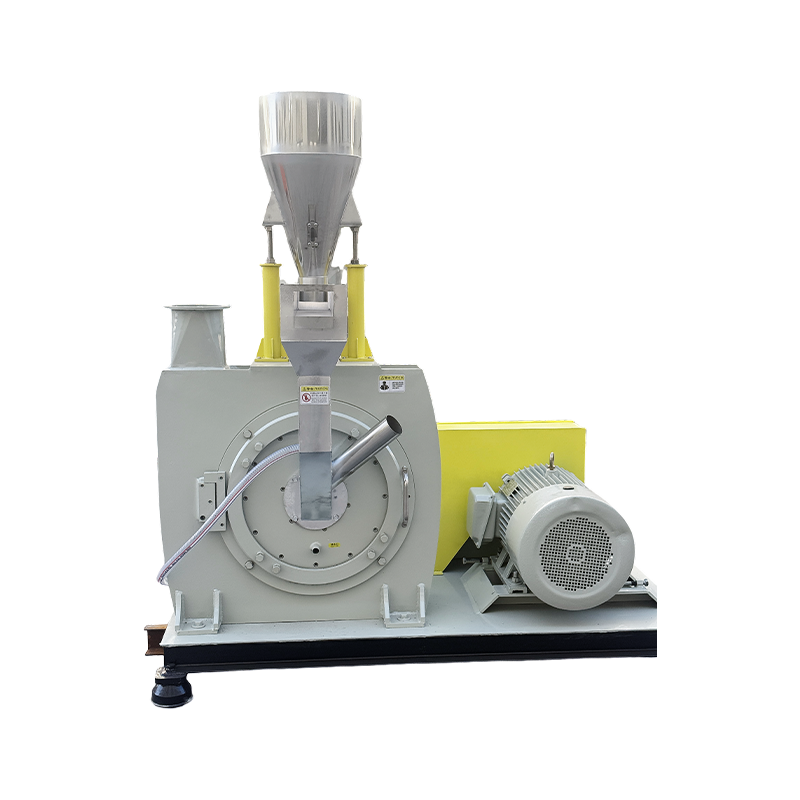
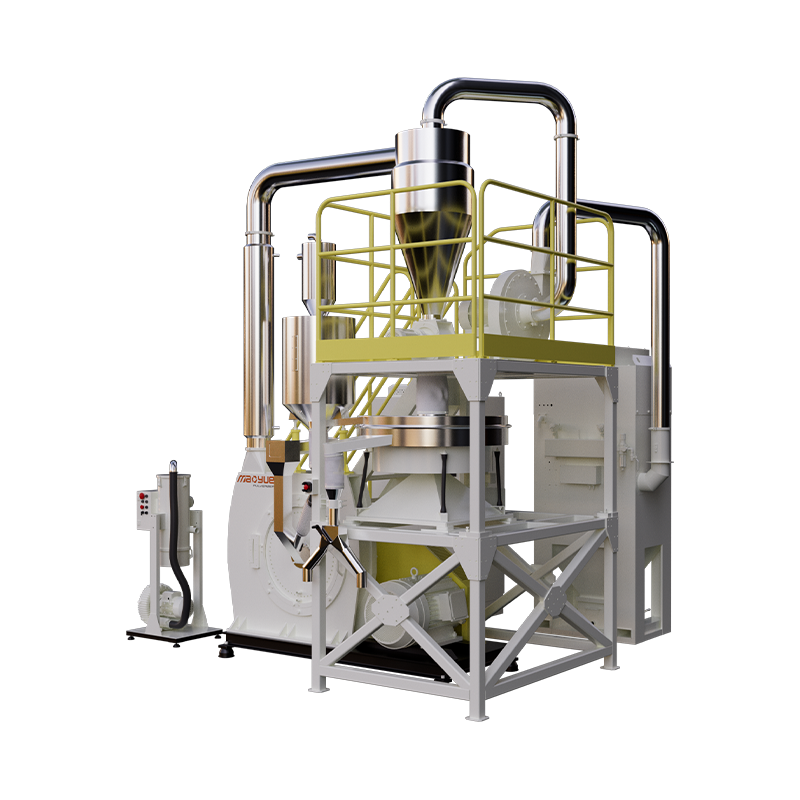
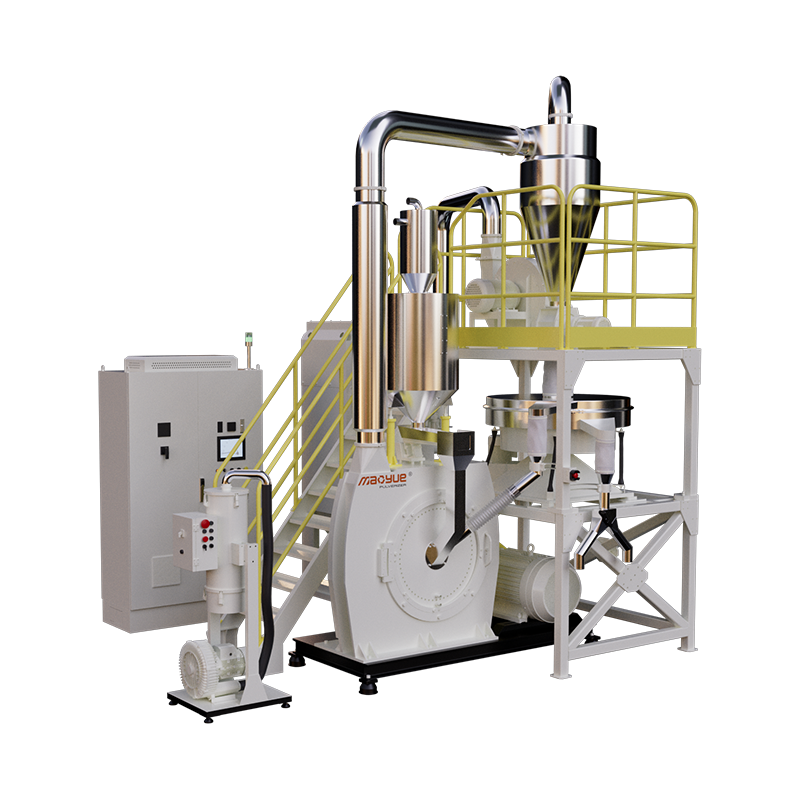 800PA/PP Room-Temperature Energy-Saving Plastic PulverizerFor PA/PP grinding where heat history affects powder quality, this room-temperature pulverizer pairs high capacity with dual-circuit cooling and ±2°C temperature control.View Product →
A simple maintenance trigger follows from this: test the first powder produced after a new blade set, then repeat at fixed intervals. When cohesion or the fine fraction moves beyond the agreed band, the tooling is due for attention. That costs far less than a rejected production lot, and it turns the flow test into a scheduling tool rather than a post-mortem.
Sampling, Conditioning and a Test Plan You Can Run Next Week
Most poor reproducibility comes from sampling, not from instruments. Take the sample from the actual process stream rather than from the top of a bag, seal it immediately, and record moisture, bulk density and particle size distribution alongside the flow value. If you are still narrowing down machine options, this overview of pulverizer types and buying tips is a sensible starting point before you commit to a specification.
- Define the decision first: hopper design, lot acceptance, or tooling wear monitoring.
- Condition samples for 24 hours at 23 degrees Celsius and 50 percent relative humidity, then recheck moisture.
- Run the chosen index method three times per sample and report the mean and range; differences under about 10 percent are usually noise.
- Test the qualification sample in a shear cell at the consolidation stress measured or estimated in your equipment.
- Retest after one, four and twelve weeks of storage to catch time consolidation and caking.
- Keep a sealed reference sample from every approved lot so future comparisons have a baseline.
Flow behaviour is one of the few quality attributes you can measure before a single part is molded, and it is cheap compared with a rejected batch. Choose the method that matches the decision in front of you, record the conditions every time, and watch the trend across lots. The direction of travel tells you more than any single reading.