

 English
 русский
 Español
 عربى
 中文简体
 中文简体
Content
- 1 What Is PE Rotomolding Powder Agglomeration?
- 2 Where Does PE Powder Agglomeration Start?
- 3 Why Does PE Rotomolding Powder Agglomerate?
- 4 Can Too Many Fine Particles Increase the Risk of Agglomeration?
- 5 Can Moisture Cause PE Powder Agglomeration?
- 6 How Can You Identify the Real Cause of PE Powder Agglomeration?
- 7 How Can PE Rotomolding Powder Agglomeration Be Reduced?
- 8 How Does Mao Yue Help Reduce the Risk of PE Powder Agglomeration?
- 8.1 Start With the Actual Agglomeration Problem
- 8.2 Evaluate PE Pulverizing Performance Through Actual Material Testing
- 8.3 Match the Pulverizing and Powder-Handling Process to the Agglomeration Location
- 8.4 Maintain Stable Pulverizing Conditions and Core Components
- 8.5 Match the Equipment and Process to Actual Production Requirements
- 8.6 Verify the Solution Through Actual Powder Condition
- 9 Frequently Asked Questions
- 10 Conclusion
PE rotomolding powder needs to maintain good flowability after production so that it can be transported, discharged, and evenly distributed during the rotomolding process.
However, during actual production, PE powder may begin to stick together during pulverizing, cooling, conveying, collection, packaging, or storage, gradually forming small lumps.
This is known as PE powder agglomeration.
It is important to understand that powder agglomeration is not the same as an incorrect particle size.
Even when PE powder has reached the target particle size, the particles may still begin to adhere to each other and form agglomerates. Therefore, evaluating powder quality requires more than checking the average particle size. Powder flowability, particle size distribution, and the presence of agglomerates should also be considered.
Step 1 in solving PE powder agglomeration is not to immediately adjust one equipment parameter. Instead, determine:
When does the powder start to stick? Where does the agglomeration start?
What Is PE Rotomolding Powder Agglomeration?
PE powder agglomeration occurs when originally separate powder particles adhere to each other and gradually form larger lumps.
Stable powder:
Individual particles → Free-flowing powder
Agglomerated powder:
Individual particles → Particle contact → Particle adhesion → Agglomerates
Where Does PE Powder Agglomeration Start?
Identifying when and where agglomeration appears can help locate the problem more efficiently.

If Agglomeration Appears Immediately After Pulverizing
If lumps are already visible when the powder comes out of the pulverizer, the pulverizing process, cooling condition, and powder condition before entering the collection stage should be checked.
Key factors include:
-
Powder condition
-
Cooling stability
-
Actual production load
-
Powder residence time
-
Particle surface condition
When agglomeration appears very early, the pulverizing and powder-handling process should be investigated first.
If Agglomeration Appears During Conveying or Collection
If the powder is in normal condition immediately after pulverizing but gradually forms lumps during conveying, screening, or collection, the downstream powder-handling process should be checked.
For example:
-
Is powder accumulating at a specific point?
-
Is heat being retained in certain areas?
-
Is the conveying process stable?
-
Is powder remaining in the collection system for too long?
-
Are powder particles staying in close contact for an extended period?
This means that troubleshooting PE powder agglomeration should not focus only on the pulverizing chamber. The entire downstream powder-handling process should also be examined.
If Agglomeration Appears After Packaging or During Storage
If the powder is in good condition during packaging but forms lumps after a period of time, attention should shift to the downstream conditions.
Check:
-
Powder condition at the time of packaging
-
Storage temperature
-
Humidity and condensation
-
Storage time
-
Compression of powder inside the package
This distinction is important because not all PE powder agglomeration problems originate from the pulverizer.
Why Does PE Rotomolding Powder Agglomerate?
PE powder agglomeration is usually not caused by a single factor.
More accurately, agglomeration occurs when the powder reaches a condition in which particles can easily come into contact and adhere to each other, and this condition remains long enough for lumps to form.
Common factors include:
-
Fine particle proportion
-
Powder accumulation
-
Conveying and collection conditions
-
Surface moisture or condensation
-
Packaging conditions
-
Storage temperature and humidity
-
Pressure applied to the powder
-
Storage time
Therefore, when analyzing an agglomeration problem, determine where and when the agglomeration occurs, and then identify the factors affecting that stage.
Can Too Many Fine Particles Increase the Risk of Agglomeration?
A high proportion of fine particles may increase the contact area between particles and therefore increase the risk of agglomeration. However, a high fine-particle fraction does not necessarily mean that fine particles are the root cause of the problem.
Therefore, PE powder analysis should consider the complete particle size distribution and the formation of agglomerates rather than relying only on average particle size.
Can Moisture Cause PE Powder Agglomeration?
PE itself has relatively low moisture absorption. Therefore, when moisture is associated with PE powder agglomeration, more attention should be paid to surface moisture and condensation.
For example:
Hot powder → enters a colder environment → possible condensation → particle adhesion
Or:
Cold powder → enters a warm, humid environment → surface moisture develops → agglomeration
This can occur when powder is packaged before it has reached a stable condition or when the storage environment experiences significant temperature changes.
How Can You Identify the Real Cause of PE Powder Agglomeration?
One of the effective methods is to investigate when and where the agglomeration appears.
This approach helps distinguish between:
Agglomeration generated during the pulverizing process and agglomeration that develops during conveying, collection, packaging, or storage.
Instead of changing multiple production parameters at the same time, a more effective approach is to compare normal and agglomerated batches and identify the point where the powder condition changes.
How Can PE Rotomolding Powder Agglomeration Be Reduced?
In actual production, the complete powder-handling process should be considered:
Pulverizing → Cooling → Screening → Conveying → Collection → Packaging → Storage
If Agglomeration Occurs After Pulverizing
Focus on:
-
Stabilizing the pulverizing conditions
-
Controlling powder temperature
-
Checking the particle size distribution
-
Minimizing unnecessary powder residence time
If Agglomeration Occurs During Conveying
Focus on:
-
Reducing powder accumulation
-
Checking conveying stability
-
Minimizing unnecessary residence time
-
Checking material transfer points
If Agglomeration Occurs During or After Packaging
Focus on:
-
Ensuring the powder has reached a stable condition before packaging
-
Avoiding packaging large quantities of powder while it is still hot or unstable
-
Controlling temperature changes
If Agglomeration Occurs During Storage
Focus on:
-
Controlling storage temperature and humidity
-
Preventing condensation
-
Reducing excessive compression
-
Monitoring storage time
How Does Mao Yue Help Reduce the Risk of PE Powder Agglomeration?
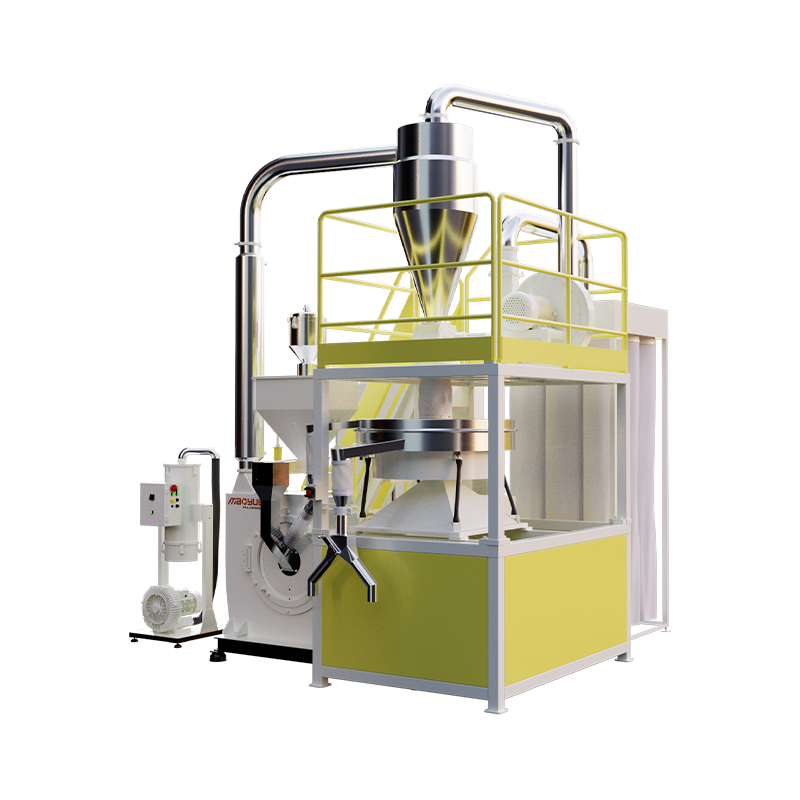
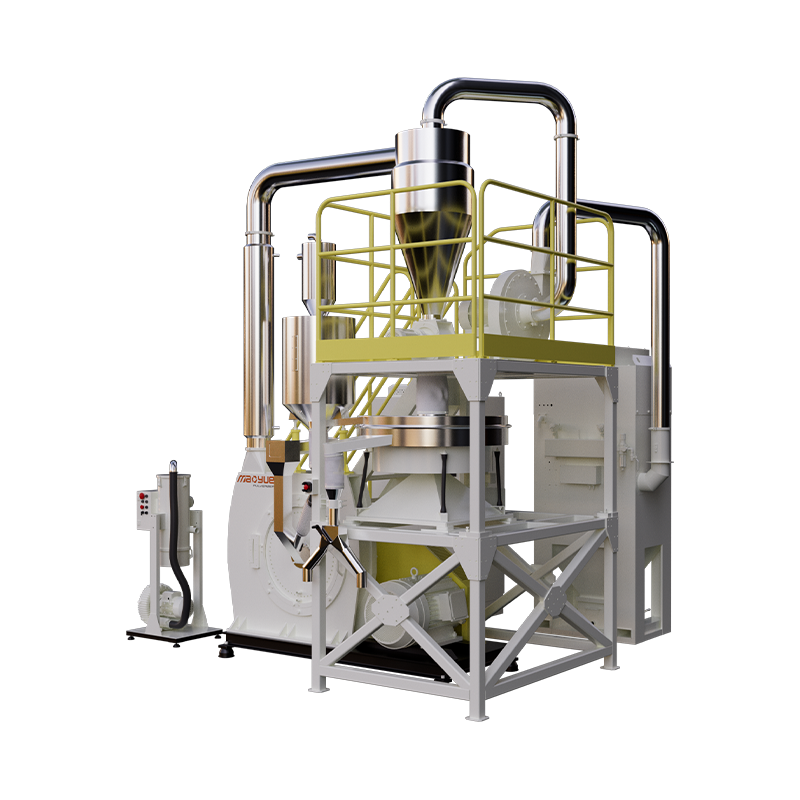
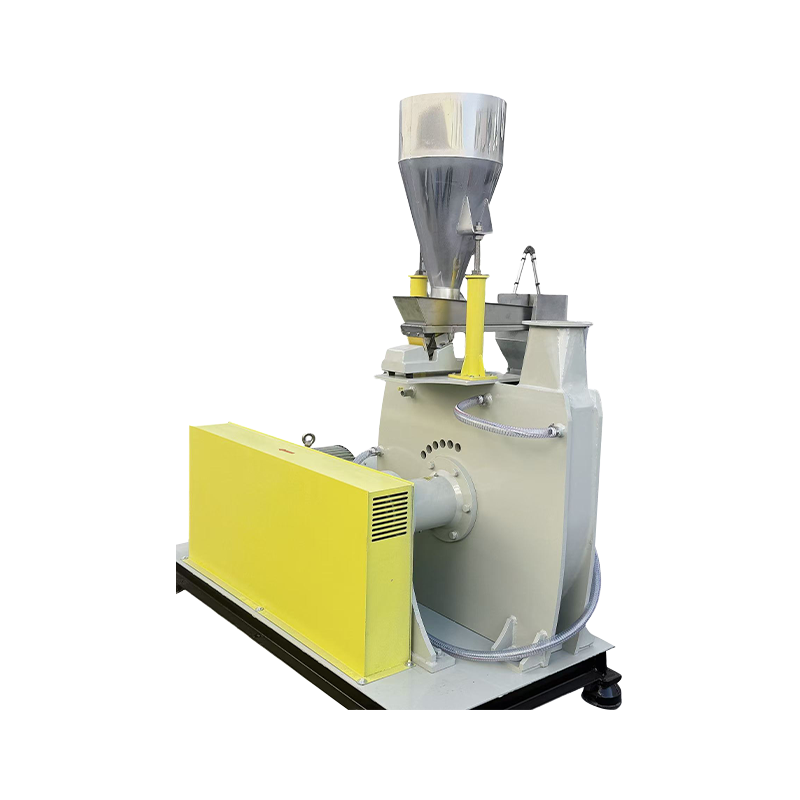
At Mao Yue, we do not simply treat PE powder agglomeration as a cooling problem. We also do not recommend a specific PE pulverizer model without understanding the material and production requirements.
We focus on one key question:
Where does your PE powder start to agglomerate, and why does it happen there?
Our evaluation process is:
Customer problem → Actual material testing → Identify the agglomeration stage → Match the pulverizing process → Verify the powder condition
Start With the Actual Agglomeration Problem
Before equipment selection, Mao Yue needs to understand the problem the customer is experiencing, such as:
-
Agglomeration appears immediately after pulverizing
-
Lumps form during conveying or collection
-
Powder gradually clumps after packaging
-
Powder begins to stick together after storage
-
Powder flowability decreases
Different agglomeration locations require different troubleshooting approaches.
Therefore, we do not simply recommend a standard solution based on the requirement for a “PE pulverizer.” We identify where the problem occurs.
Evaluate PE Pulverizing Performance Through Actual Material Testing
Mao Yue can test the customer's actual PE material instead of relying only on theoretical equipment parameters to determine whether a pulverizer is suitable.
Before testing, we need to understand:
-
PE material type
-
Raw material size
-
Target particle size
-
Required capacity
-
Daily operating hours
-
Final rotomolding application
-
Current agglomeration problem
Mao Yue does not only check whether the machine can pulverize PE to the target particle size. We also observe how the powder condition changes during pulverizing, cooling, screening, and collection.
Match the Pulverizing and Powder-Handling Process to the Agglomeration Location
If agglomeration occurs after pulverizing, the relationship between pulverizing conditions and powder condition needs to be analyzed.
If the powder is normal immediately after pulverizing but agglomerates during conveying, collection, packaging, or storage, the downstream powder-handling conditions need to be examined.
Therefore, Mao Yue focuses not only on the pulverizer itself, but on the complete process:
Pulverizing → Cooling → Screening → Conveying → Collection → Packaging
The key is to ensure that the different stages of powder handling work together properly.
Maintain Stable Pulverizing Conditions and Core Components

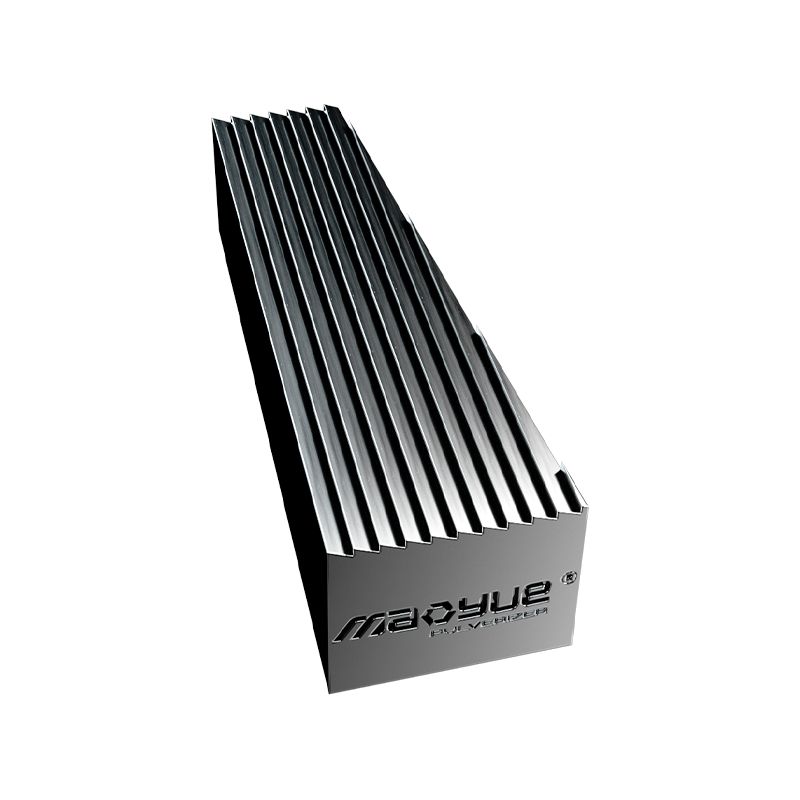
Mao Yue manufactures its own core pulverizing discs and blades and performs precision machining and strict inspection on key components.
Stable disc and blade conditions help maintain a consistent pulverizing gap and stable pulverizing conditions, reducing the risk of significant changes in particle size distribution during production.
For PE rotomolding powder, a stable particle size distribution is one of the foundations for maintaining consistent powder condition and flowability.
Match the Equipment and Process to Actual Production Requirements
After the problem and material characteristics have been identified, the pulverizing process and downstream powder-handling solution can be matched according to:
Material + Target Particle Size + Capacity + Operating Hours + Application + Agglomeration Problem
Verify the Solution Through Actual Powder Condition
The final goal is not simply to confirm that the equipment can operate. The goal is to verify whether the pulverizing process can produce powder that meets the customer's requirements.
Key factors may include:
-
Particle size distribution
-
Agglomeration
-
Powder flowability
-
Powder condition stability
-
Actual production capacity
-
Downstream collection performance
Actual material testing and production-condition matching can reduce the risks associated with selecting equipment based only on nominal specifications.
If your PE rotomolding powder is already experiencing sticking, clumping, agglomeration, or reduced flowability, provide Mao Yue with your actual material, target particle size, required capacity, and current powder problem.
Mao Yue can analyze where the agglomeration starts and evaluate a suitable PE pulverizing and powder-handling solution based on actual material testing.
Frequently Asked Questions
Why Does My PE Powder Stick Together?
PE powder may stick together because of powder condition, surface moisture, conveying, packaging, or storage conditions. The step is to identify where the sticking starts.
How Can I Prevent PE Powder From Clumping?
First identify where the clumping starts, then check the powder condition, conveying, packaging, or storage conditions at that stage instead of changing all production parameters at once.
Is PE Powder Agglomeration the Same as Coarse Particles?
No. Coarse particles are oversized particles within the particle size distribution, while agglomeration occurs when originally separate particles adhere to each other and form larger lumps.
Can Cooling Reduce PE Powder Agglomeration?
Stable cooling can help maintain a consistent powder condition, but PE powder agglomeration should not be treated as a cooling problem alone. Conveying, packaging, humidity, and storage conditions can also contribute to agglomeration.
Why Does PE Powder Only Clump After Storage?
This may be related to condensation, temperature changes, powder compression, packaging conditions, or storage time.
How Should I Choose a Suitable PE Pulverizer?
Actual material testing is recommended. Provide the PE material, target particle size, required capacity, operating hours, and current agglomeration problem so that the complete powder-handling process can be evaluated.
Conclusion
PE rotomolding powder agglomeration does not necessarily mean that the pulverizer itself has a problem.
A more effective troubleshooting approach is to determine:
When does the powder start to stick? Where does the agglomeration start?
Therefore, PE powder agglomeration should be evaluated across the complete process:
Pulverizing → Cooling → Screening → Collection → Packaging → Storage
If your PE rotomolding powder is experiencing sticking, clumping, agglomeration, or reduced flowability, provide Maoyue with:
PE material + Target Particle Size + Required Capacity + Current Powder Problem
Mao Yue can conduct actual material testing and help evaluate a suitable PE pulverizing and powder-handling solution.
Even if you already have a PE pulverizer, you can still provide your actual production conditions if your current powder is experiencing agglomeration or reduced flowability. We can evaluate the problem based on your existing process and powder condition.