

 English
 русский
 Español
 عربى
عربى 中文简体
中文简体
 中文简体
中文简体
Content
If your plastic powder forms a stable bridge in the hopper on Monday and floods the screw on Tuesday, you have a flowability problem, not a machine problem. The same pulverizer can produce a batch that discharges cleanly and the next batch that hangs up, causing inconsistent dosing, surging, and rejected parts. In practice, powder flowability is the property that decides whether your downstream process runs smoothly or stops for manual knock-down. This guide explains what flowability means, which variables you must control, and what to look for when evaluating a pulverizer for free-flowing powder.
What Powder Flowability Actually Means
Unlike density or particle size, flowability is not a single intrinsic material property. It is a derived property that describes how a powder behaves as a bulk assembly under a specific set of equipment conditions. A powder that flows well in a large silo can behave completely differently in a small vibratory feeder. That is why experienced processors treat flowability as a system property: material plus equipment plus environment.
In plastic pulverizing, the goal is to produce a powder that feeds consistently, hoppers empty without bridging, and the material transports through screws, pipes, and dies without surging. When you see sticky, agglomerated batches, you are looking at a flowability failure. Understanding the underlying factors is the first step to fixing it. For a deeper look at the machine side, see our what is plastic pulverizer overview.
Factors That Drive Powder Flow in Plastic Pulverizing
The following factors matter most when you process thermoplastics into powder.
Particle Size Distribution (PSD)
PSD is the strongest predictor of flow. A narrow distribution around D50 reduces the number of fine particles that fill gaps between larger particles and increases internal friction. If your D90/D50 ratio is too high, you get a wide distribution with excessive fines, which raises cohesion and causes flow blockage. When you buy a pulverizer, ask for a representative PSD curve. For rotomolding and masterbatch applications, a narrow span of 2.0 to 3.0 is a practical target.
Particle Shape and Surface Texture
Irregular, flaky particles interlock and resist flow. Ball-shaped or rounded particles move more freely. A balanced blade and disc design creates particles with lower aspect ratios, reducing mechanical interlocking. Also, a rough surface increases frictional drag, while a smooth surface reduces it. This is why the choice of grinding mechanism matters.
Moisture and Temperature
Surface moisture creates liquid bridges between particles, dramatically increasing cohesion. Even a small change from 0.1% to 0.3% water can turn a free-flowing powder into a sticky mass. Temperature also affects thermoplastics: if the mill runs hot, the powder can soften, weld together, and lose flow. That is why ambient-temperature grinding without liquid nitrogen is a significant advantage for PA and PP materials.
Electrostatic Charge
Plastic powders are insulators and pick up static charge easily. Oppositely charged particles attract, form aggregates, and stick to metal surfaces. Use of grounded equipment, proper anti-static design, and appropriate rotor speed can suppress this effect.
How to Measure Powder Flowability
You cannot manage what you do not measure. Standardized tests let you compare your powder against acceptance criteria and specify equipment meaningfully.
| Method | Measurement | Free-Flowing Range | Practical Note |
|---|---|---|---|
| Angle of Repose | Pile angle after pouring | 25-35 degrees | Simple, but sensitive to drop height |
| Hausner Ratio | Tapped bulk density / aerated bulk density | Less than 1.25 | Good indicator for powders in bins and hoppers |
| Carr Index | (Tapped - Aerated) / Tapped x 100 | Less than 20% | Requires careful tapping protocol |
| Orifice Flow Rate | Mass flow through a defined aperture per time | Directly measured | Most representative for screw-fed lines |
Angle of repose gives a quick qualitative check. Hausner ratio and Carr index give useful rankings for hopper design. Orifice flow tells you how the material will actually feed through a screw or valve. For procurement, request all three on the same powder you plan to process. Compare the results against the free-flowing ranges above and use the data as part of your acceptance test.
How Equipment Design Improves Powder Flow
The right pulverizer does more than reduce particle size. It controls the entire particle population and thermal history. Here are the design features that directly improve flow:
- Adjustable disc speed and gap — A wider gap produces coarser powder, which may flow better but may not meet your process requirements. A narrower gap gives finer powder but can generate more fines. The ability to tune this balance is essential.
- Wear-resistant alloy steel blades and discs — Worn tools create uneven particle shapes and excess fines, destroying flow consistency. Hardened components hold their geometry, keeping the PSD stable for many tons.
- Temperature control — Ambient-temperature pulverizing prevents heat-related agglomeration without requiring liquid nitrogen. This is especially valuable for PP and PA, where cryogenic grinding adds cost and complexity.
- Air classification or integrated screening — Removing oversize and ultra-fine fractions from the outlet stream tightens the PSD and directly improves flow.
For example, when processing PA or PP, an ambient-temperature grinder that does not rely on liquid nitrogen reduces operating costs while producing a powder that remains free-flowing at the point of use. In rotomolding, high-uniformity output is what tells you that the powder will fill a mold consistently and demold cleanly.
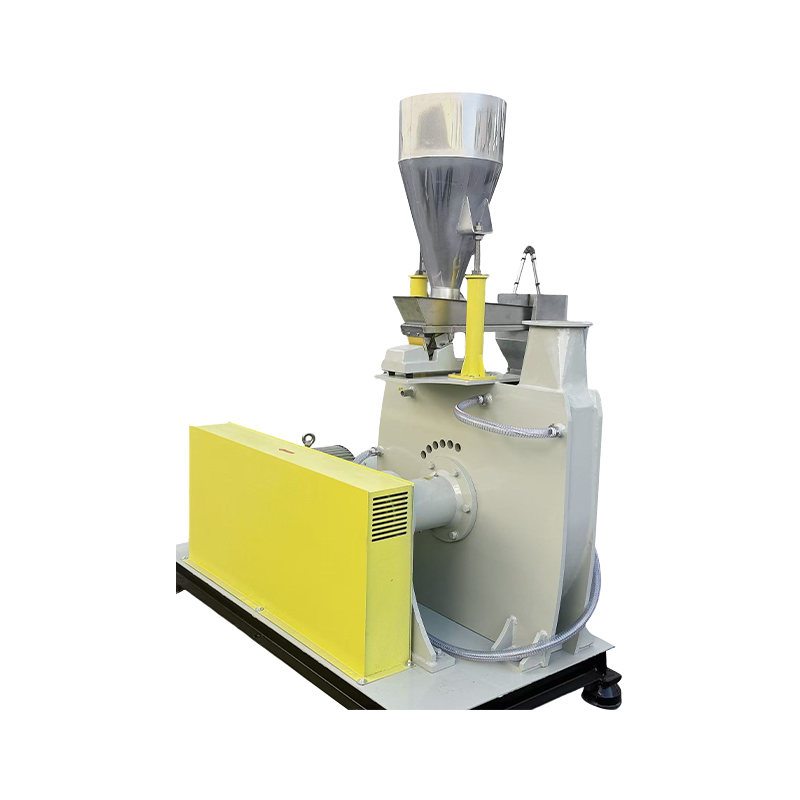
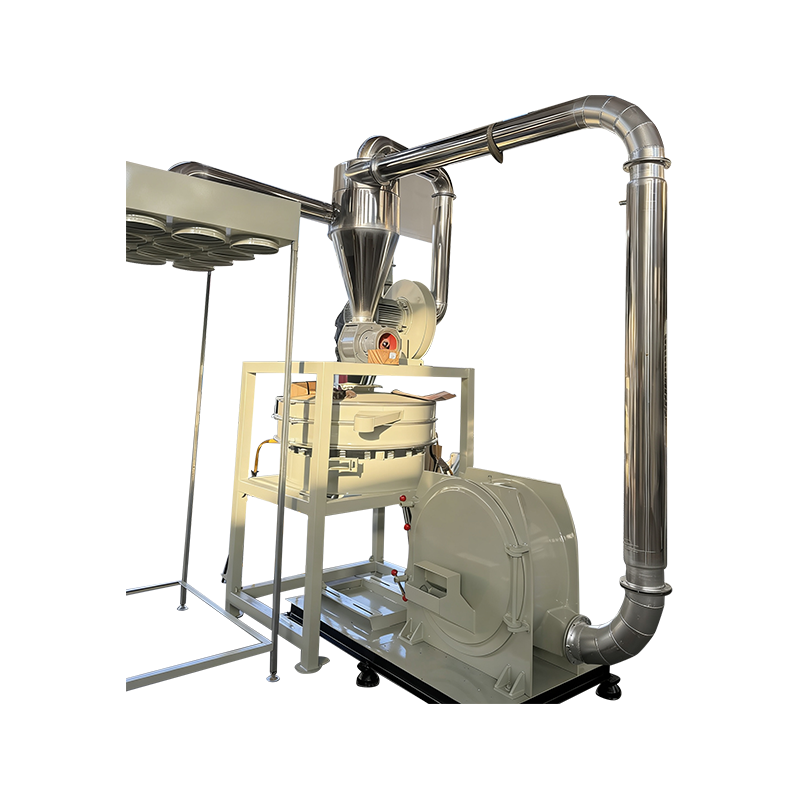
 Ambient Temperature PA/PP Pulverizer Without Liquid NitrogenThis pulverizer processes PA and PP at ambient temperature, eliminating liquid nitrogen costs while producing free-flowing powder. Its efficient grinding disc and controlled temperature prevent degradation and melt adhesion, making it cost-effective for small to medium-sized operations.View Product →
Fine PVC Powders: A Special Case
PVC pulverizing presents its own flowability challenges. The target is often a fine powder with high surface area, which is inherently more cohesive. At the same time, PVC degrades if the grinding zone gets too hot. A fine-powder pulverizer must balance narrow PSD with controlled temperature to keep the powder flowing. Look for a machine that offers a high-efficiency grinding disc with a larger rotor, as it helps discharge material quickly and avoid over-milling.
When the system produces the right particle population, you get a powder that flows through the cyclone and into the baghouse without clogging, which is exactly where flowability matters most.
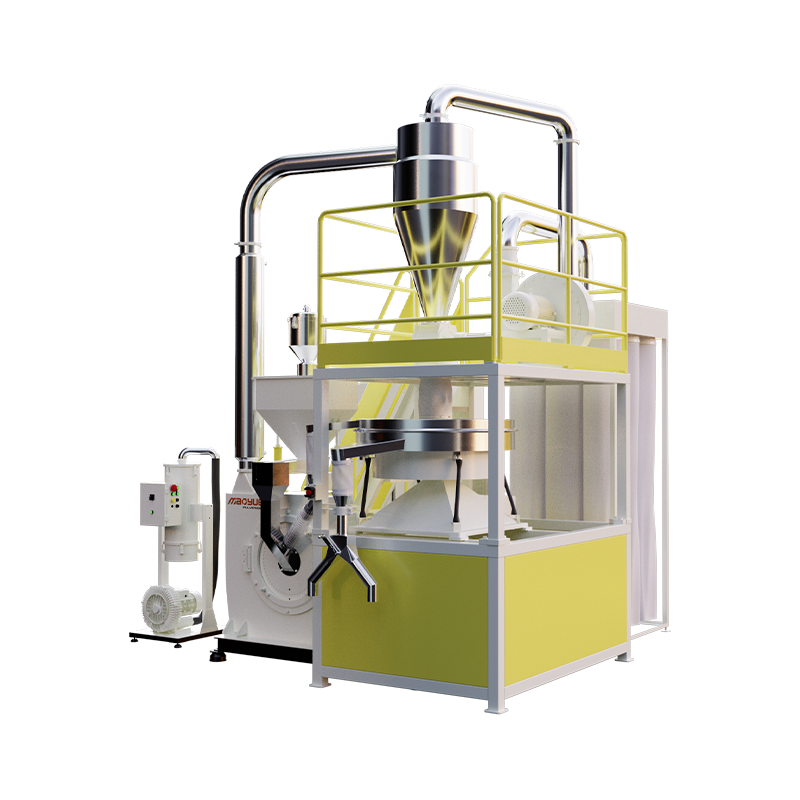
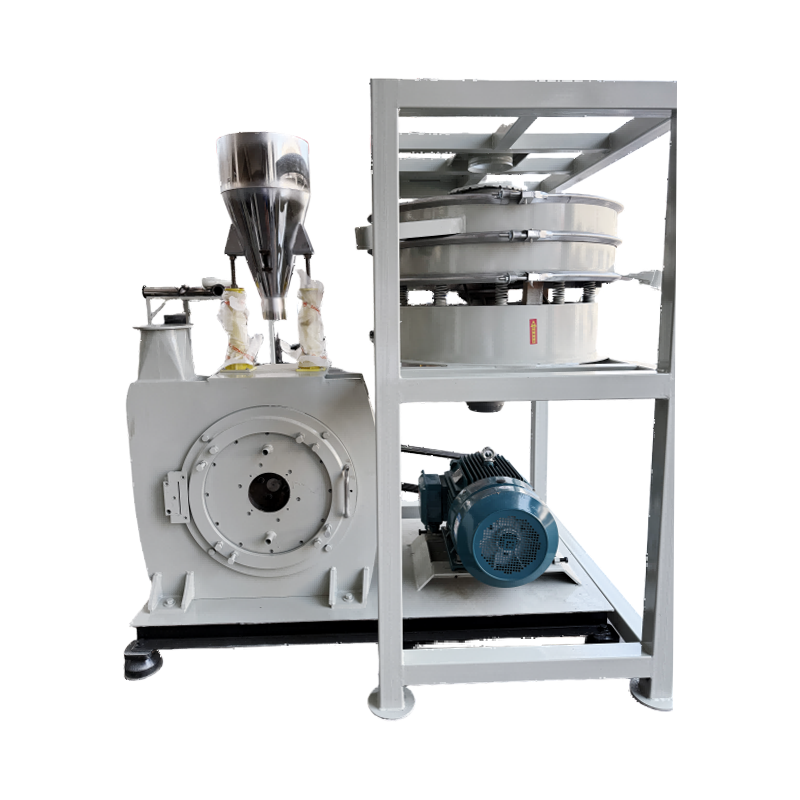
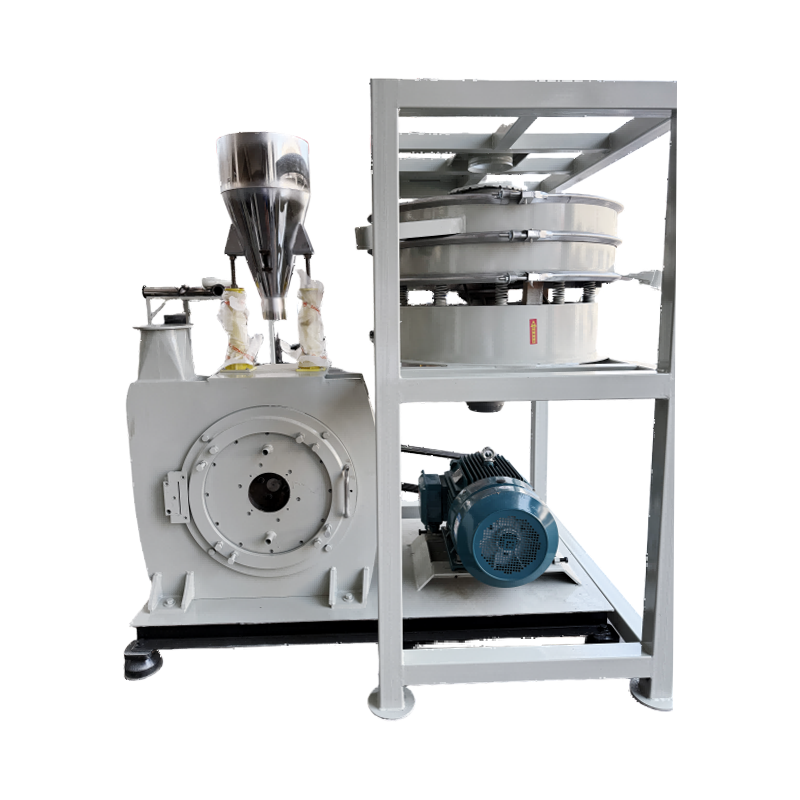
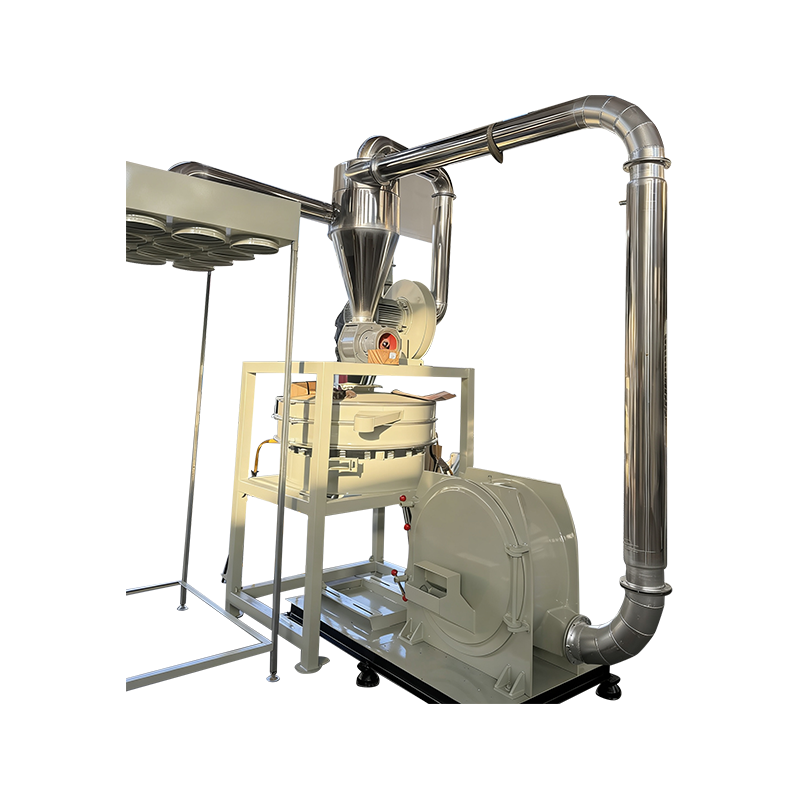 High-Capacity PVC Fine Powder Pulverizer for Large-Scale RecyclingDesigned for high-output PVC recycling, this 900mm pulverizer delivers up to 1300 kg/h with durable alloy discs lasting 1500-2200 hours. Dual-circuit cooling and vibration damping ensure stable, color-stable powder even in 24/7 continuous operation.View Product →
What to Check Before You Buy a Pulverizer
When you compare quotes from pulverizer manufacturers, use the following checklist to avoid making a decision based only on price. For a broader context on selection factors, read our plastic pulverizer guide.
- Request a PSD report for your actual material at your target capacity. Look at D50, D90, and the span.
- Ask for a flowability test on the resulting powder. A supplier that can provide angle of repose and Hausner ratio data is showing you they understand the downstream implications.
- Inspect the grinding components — Are the blades and discs hardened alloy steel? What is the expected service life in tons? What is the replacement cost?
- Check thermal performance — Does the machine control bearing and chamber temperature? For heat-sensitive materials, does it run at ambient temperature?
- Look at throughput stability — A machine that overgrinds on the first batch and undergrinds later will give you a moving flowability standard. Ask for a capacity guarantee with tolerance, such as ±5% on the D90.
High-uniformity rotomolding powder is a good test case. If the equipment produces a stable, uniform particle population, you will see less product waste and more repeatable cycle times.
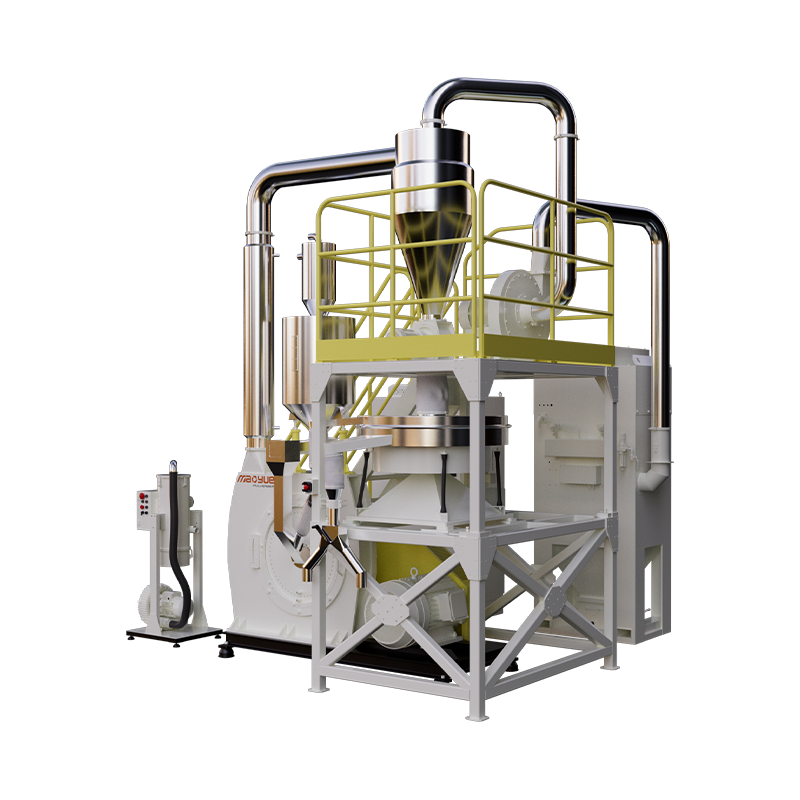
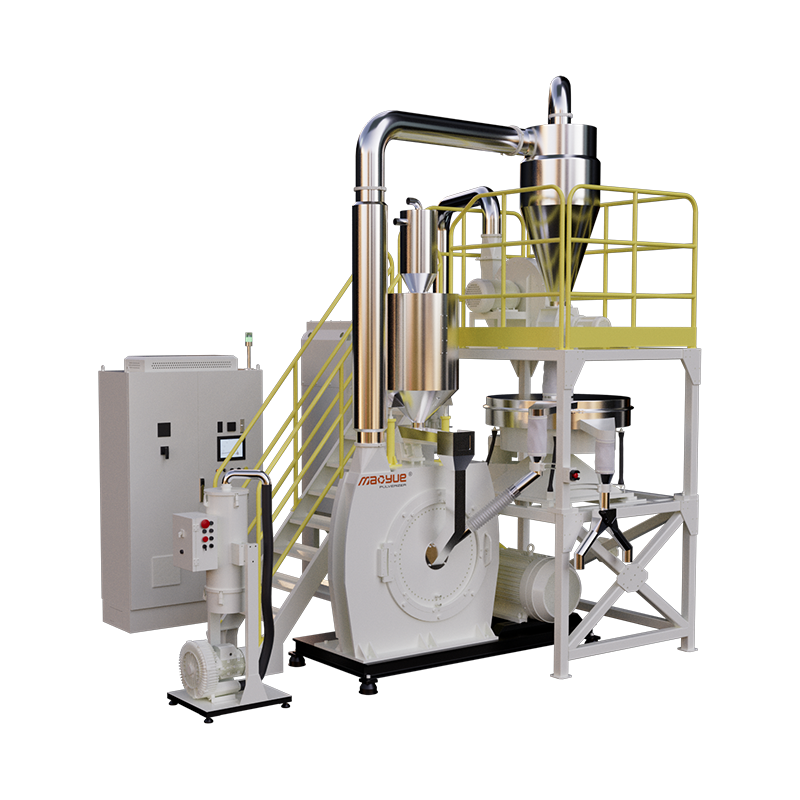
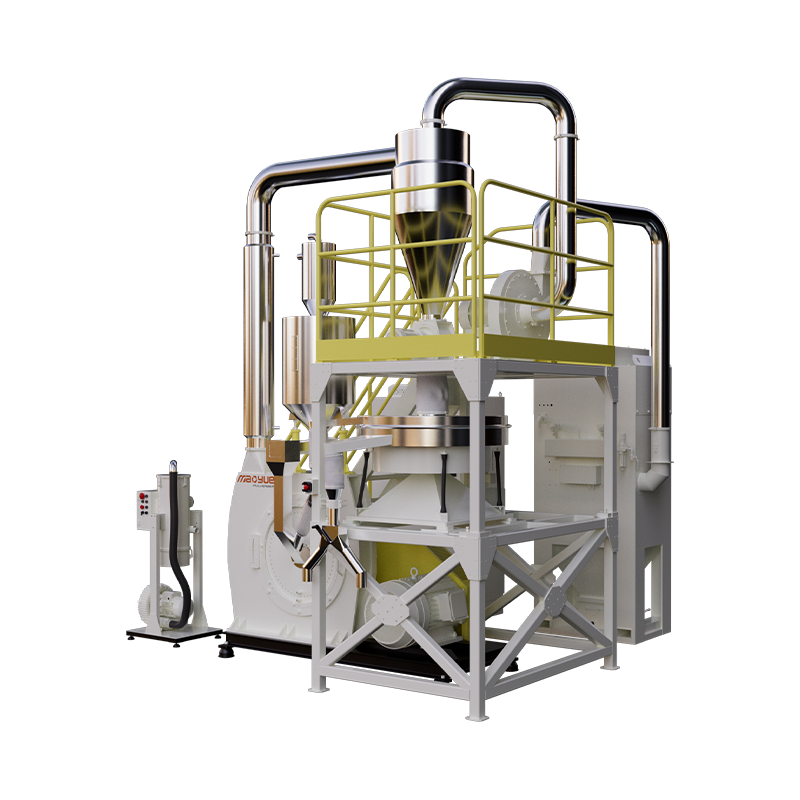 High-Uniformity PE Rotomolding Pulverizer for Large-Scale ProductionEngineered for rotomolding, this 800-model pulverizer produces 600-1500 kg/h with particle sizes from 20-100 mesh. Its precision-ground DC53 discs ensure narrow particle distribution, reducing product defects like rough surfaces and uneven thickness.View Product →
Powder flowability has a direct impact on production uptime, product quality, and process safety. It is not a cosmetic metric; it is the difference between a silo that empties and one that needs a hammer. By understanding why flow fails, how to measure it, and which equipment features prevent it, you can specify a pulverizer that delivers a consistent, free-flowing powder—not just a smaller one.
When you assess your next machine, use the tests and ranges described here as your acceptance baseline, and make sure the supplier can prove that their equipment will maintain that performance over the life of the disc and blade set.