

 English
 русский
 Español
 عربى
 中文简体
 中文简体
Content
- 1 How the two machines divide the work
- 2 Crusher applications: volume reduction before anything else
- 3 Pulverizer applications: where particle size distribution decides quality
- 4 Target fineness by application
- 5 Running a crusher and a pulverizer as one line
- 6 What to confirm before committing to a machine
Take a processor running 400 kg/h of PE purge and rejected mouldings. A crusher alone reduces that material to 8–12 mm flakes that convey well but sell poorly. Send the same flakes through a pulverizer and they leave as a 35-mesh powder that can go straight back into the rotomolding line. Identical scrap, two very different values.
That gap marks the practical boundary between crusher applications and pulverizer applications. Crushers cut material down to a size that can be handled, conveyed, re-melted or sold. Pulverizers refine granulate into powder with a controlled top size. Choosing one, or the right pair, starts with the particle size your next process can accept, not with the machine's footprint or its price tag.
How the two machines divide the work
Both machines reduce size, and that is roughly where the similarity ends. A crusher is a knife machine working against a screen; a pulverizer is a mill working against a disc or rotor with air or a screen controlling what escapes.
| Attribute | Crusher / granulator | Pulverizer / mill |
|---|---|---|
| Primary job | Reduce lumps, purging, pipe, film and sheet to a conveyable granulate | Grind granulate or pellets into powder with a controlled top size |
| Typical output | 6–12 mm flakes or regrind | Roughly 200–800 µm powder, commonly described as 20–80 mesh |
| Feed it accepts | Purge blocks, skeins, profiles, bales, thick sheet | Flakes, granules, pellets, small offcuts |
| Tooling | Rotating knives against bed knives, with a screen setting the exit size | Disc or rotor with alloy steel blades, plus air classification or a screen |
| Typical failure mode | Stringers, excess fines, blinded screens from soft material | Heat build-up, wide particle size distribution, worn disc or blade edges |
| Best fit | Volume reduction, in-house recycling, feeding an extruder | Rotomolding powder, masterbatch, PVC dry blend, compounding |
In most plants the crusher is stage one and the pulverizer is stage two. That order matters: an inconsistent granulate from the crusher shows up later as unstable throughput and a drifting particle size distribution at the mill.
Crusher applications: volume reduction before anything else
Crushers earn their place wherever material arrives in a shape that no downstream equipment will accept. The application list is short but demanding.
- Purge and start-up lumps from injection moulding and extrusion, which can otherwise only be sold as low-grade scrap.
- Pipe, profile and sheet reject, where long sections must be broken into short granules before they bridge in a hopper.
- Film, fibre and thin-wall parts, which need an aggressive feed and a screen size chosen to avoid wrapping around the rotor.
- Closed-loop regrind, where the granulate goes straight back into the same product and contamination control becomes the whole argument.
Two settings decide whether a crusher performs or fights you: screen hole size and knife condition. A 10 mm screen on brittle PVC behaves nothing like a 10 mm screen on tough PE; and a knife edge that has rounded by a fraction of a millimetre multiplies fines and cutting heat. If granulate feeds a pulverizer next, treat the crusher screen as the first control on your final powder spec.
Pulverizer applications: where particle size distribution decides quality
Powder is judged by numbers, and those numbers change from one process to the next. Four applications cover most of the demand, and each one stresses a different machine property. If you are still weighing machine types at this stage, our practical pulverizer selection guide walks through the categories in more detail.
Rotomolding with PE
Rotational moulding needs powder that melts evenly across the mould wall. Oversized particles leave unmelted specks; an excess of very fine material causes bubbles, smoke and inconsistent wall thickness. The practical target is a narrow band around 35 mesh, with dry flow and bulk density tracked as well. Uniformity, not average fineness, is the specification that decides whether a moulding passes.
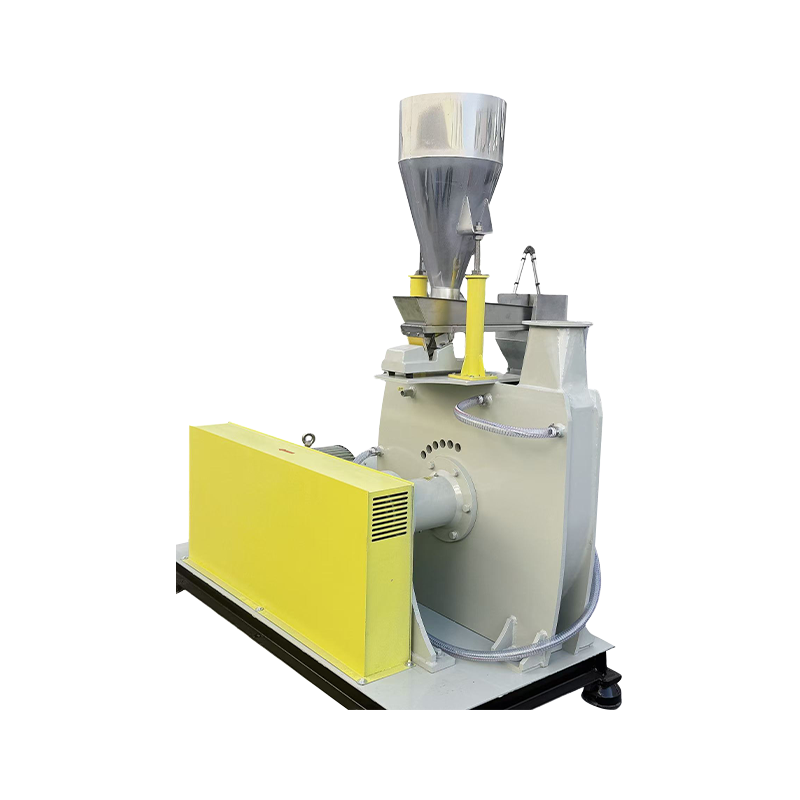
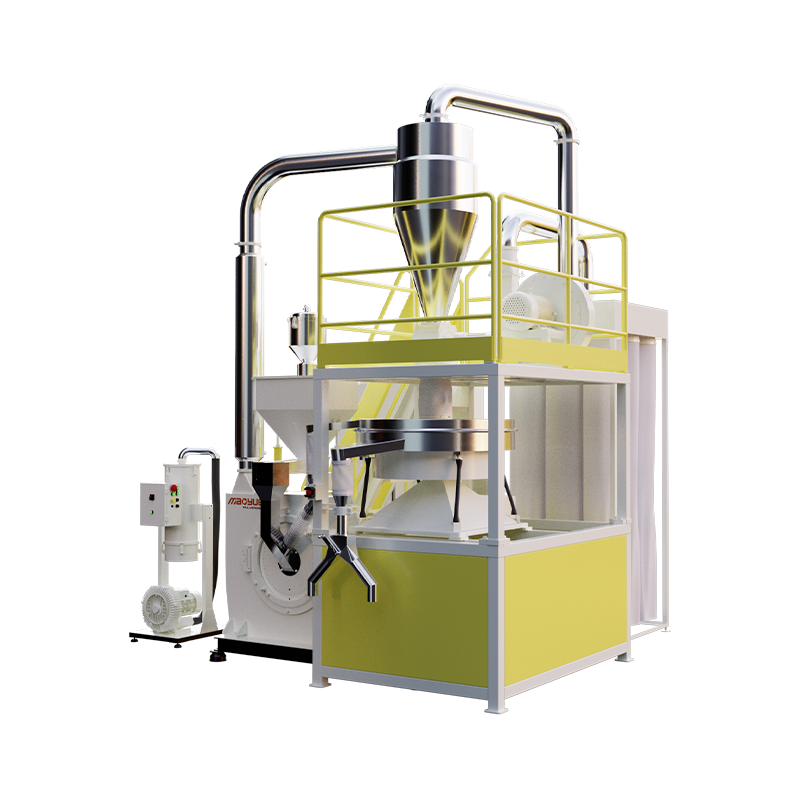 Mao Yue 600 PE Rotomolding PulverizerFor rotational moulding lines seeking uniform PE powder, this 600 mm disc pulverizer offers adjustable fineness, vacuum feeding, water cooling, and dust collection.View Product →
Masterbatch and polymer compounds
Colour masterbatch and filled compounds need fine, well-dispersed powder so that pigment or filler distributes evenly in the carrier. Throughput matters here because masterbatch runs are short and frequent, so changeover time and cleaning access count as much as motor power. High-capacity mills in the 800 class are normally specified when a single formulation runs for hours.
PA and PP
Polyamides and polypropylene are tough and heat-sensitive, which is why cryogenic grinding with liquid nitrogen became the default for years. Ambient-temperature grinding avoids that consumable cost entirely: no nitrogen supply, no insulated storage, no per-kilogram cooling charge. The trade-off is that the mill must manage rotor heat through airflow and disc geometry rather than temperature. Wear-resistant builds suit glass-filled or abrasive grades, while energy-saving builds target continuous operation on neat resin.
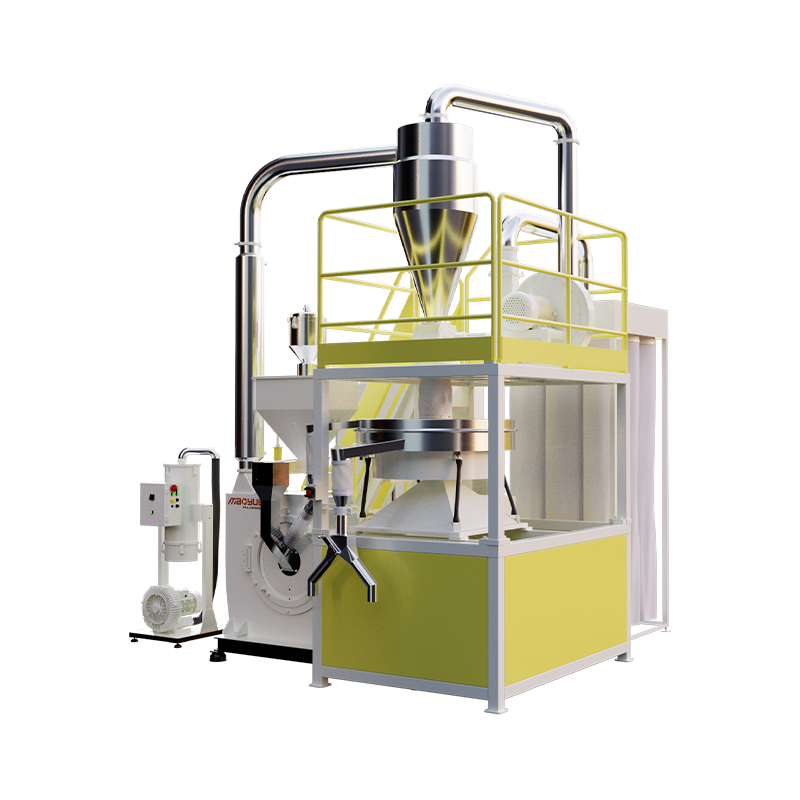
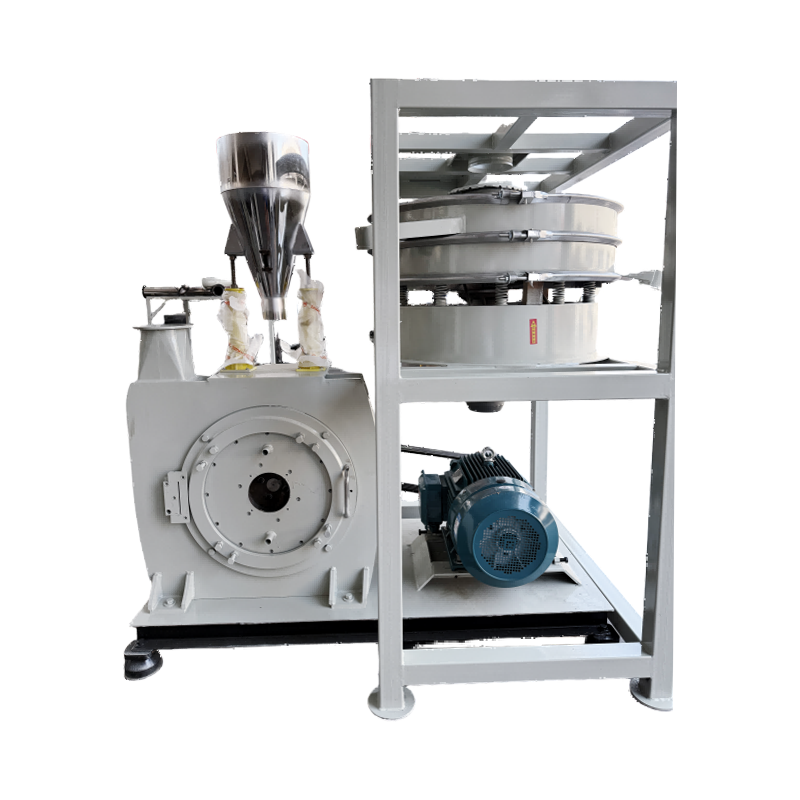 Mao Yue PA/PP-500 Ambient-Temperature PulverizerFor small-to-medium PA and PP recycling or trials, this entry-level mill avoids liquid nitrogen and supports quick material changes with integrated screening.View Product →
PVC
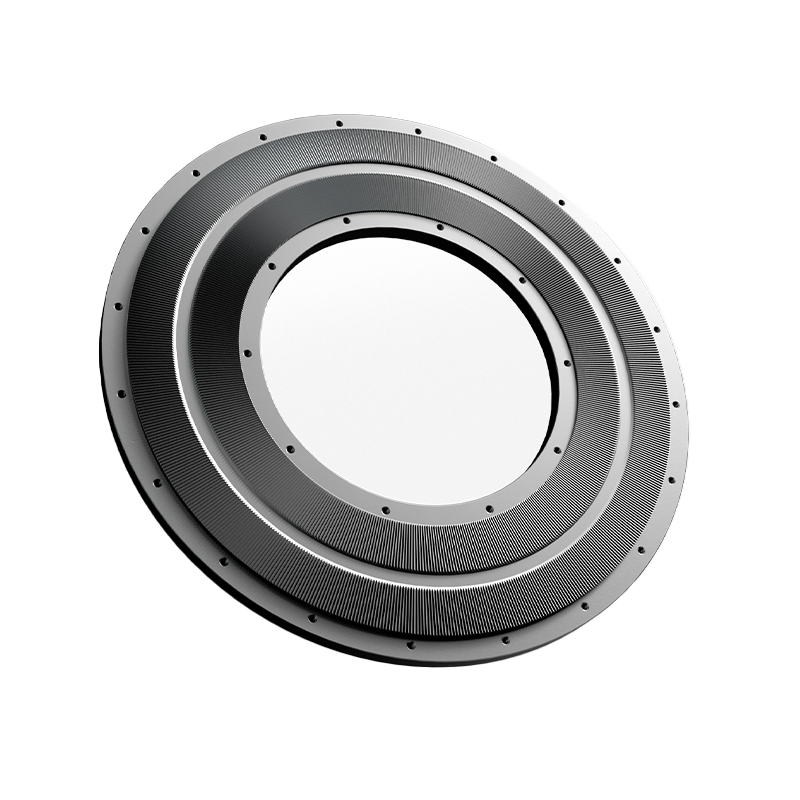
PVC is the least forgiving of the group. It degrades with heat, it is abrasive on tooling, and dry-blend users expect a tight sieve cut. Mills for this material are typically specified around wear life and temperature control: alloy steel blades, heavy discs and generous air movement. Fine-powder models push the cut finer for paste and dry-blend work, while wear-resistant models are chosen where regrind contains filler.
Target fineness by application
Mesh numbers are a shorthand, not a specification. Ask for a sieve analysis and a distribution curve, because two powders that both "pass 35 mesh" can behave completely differently on the same mould.
| Application | Common target | What to test before buying |
|---|---|---|
| PE rotomolding | Around 35 mesh, narrow distribution | Full sieve curve, bulk density, dry flow rate, gel count |
| Colour masterbatch | 40–80 mesh depending on carrier | Dispersion quality, residue on finest sieve, changeover time |
| PA / PP ambient grinding | 30–60 mesh | Outlet temperature, throughput stability over a full shift, blade wear |
| PVC dry blend and paste | 40–100 mesh | Heat history, metal contamination, disc and blade life |
Running a crusher and a pulverizer as one line
Once both stages exist, the interesting engineering is in the handover. A conveyor or air feed sized for the crusher's peak output prevents the mill from starving and surging; a metal detector and a magnet before the mill protect the disc; and a buffer silo between the two stages lets each machine run at its own rhythm rather than in lockstep.
Purpose-built lines compress this into a single frame with matched capacities and one control point. Blade-type lines suit general regrind where a clean cut matters, while hammer, impact and swing-knife configurations handle mixed or contaminated feed that would damage a fixed knife set.
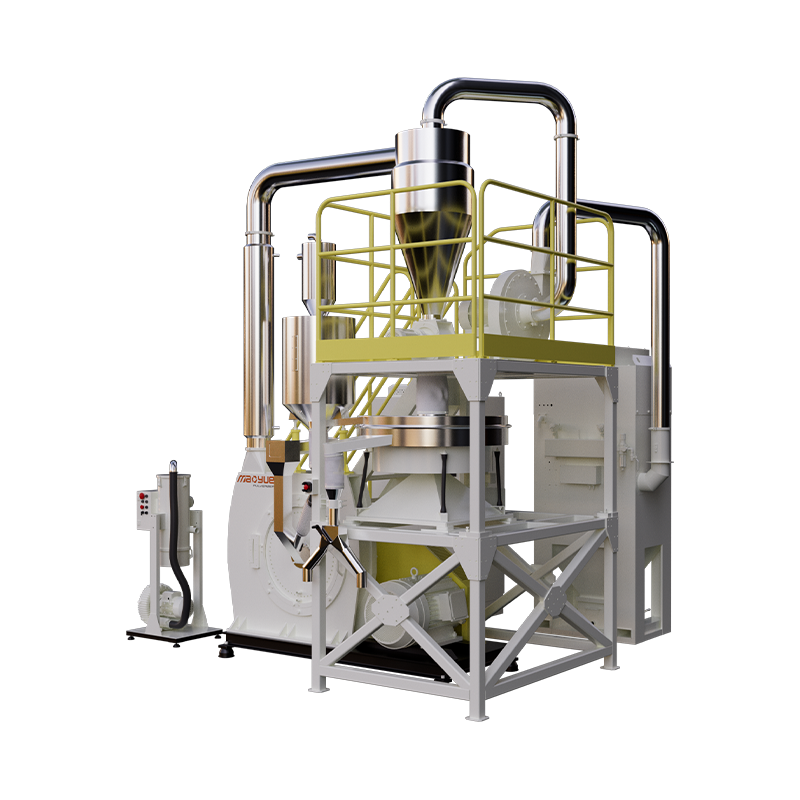
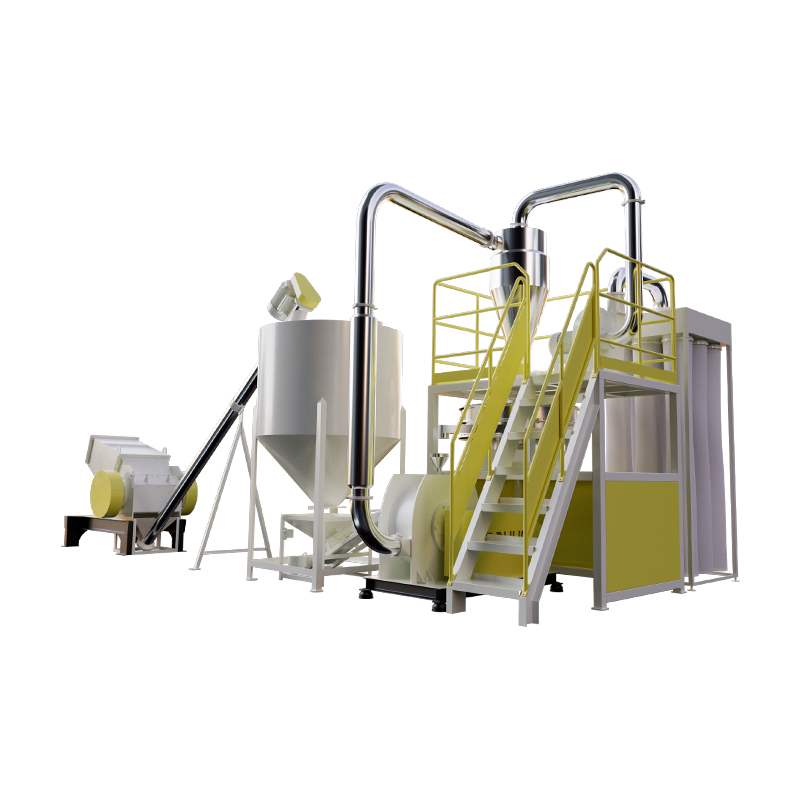 Blade-type crushing and pulverizing production lineIt is particularly suited for high-value recycling and regeneration of materials like PVC, PE, PP, PET, ABS, and EVA. The Mao Yue Blade-Type Crushing-Grinding Producti...View Product →
What to confirm before committing to a machine
Most disappointing installations trace back to a specification built on someone else's material. Work through this list with your own samples in hand.
- Run a trial on your actual scrap, not on virgin pellets, and ask for a sieve analysis of the output rather than a single mesh figure.
- Confirm the wear parts: blade material and hardness, disc type, and how many hours a set realistically delivers on your filler content.
- Check the size reduction chain end to end, including how the crusher screen interacts with the mill's target cut.
- Ask what controls the top size, air classification or a screen, and how quickly that setting can be changed for a different product.
- Price the consumables and spares over two years, not just the machine, and confirm lead times on discs, rotors and blade sets.
- Ask for machine videos or a factory visit covering the exact model and material you intend to run.
Crusher and pulverizer applications overlap far less than the shared word "size reduction" suggests. One machine exists to make material manageable; the other exists to make it measurable. Get the sequence right — crusher for shape, pulverizer for distribution — and the powder spec stops being a source of arguments between production and quality. Get it wrong, and no amount of tuning at the mill will recover a granulate that was never consistent to begin with.